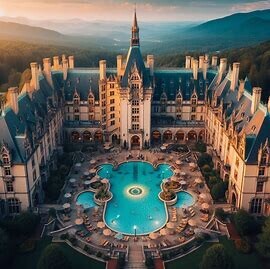
The grand rooms of Biltmore House tell one story. Look a little closer, though, and another begins to emerge.
Doors disappear into paneled walls. A trapdoor once allowed plants to move through the house without disturbing guests. Hundreds of workers labored behind the creation of George Vanderbilt’s country estate, sometimes pushing back against the conditions under which they worked. During World War II, visitors unknowingly walked past a room holding some of America’s most valuable works of art. And over the years, stories have circulated about voices, footsteps and other unexplained happenings inside the enormous house.
Some of these stories are thoroughly documented. Others belong to the folklore that grows around old houses and the people who once lived in them.
Together, they reveal a Biltmore quite different from the magnificent château seen from the front lawn.
For the larger story of George Vanderbilt and the creation of the estate, begin with our guide to The Biltmore Estate: America’s Largest Home.
🚪 The Doors Biltmore’s Guests Weren’t Meant to Notice
Biltmore’s so-called “secret doors” aren’t really secret at all. Biltmore’s curators describe them more accurately as concealed doors and passageways, and they served several purposes. Some preserved the symmetry of George Vanderbilt’s carefully designed rooms. Others allowed household employees to do their work without continually crossing the family’s living spaces.
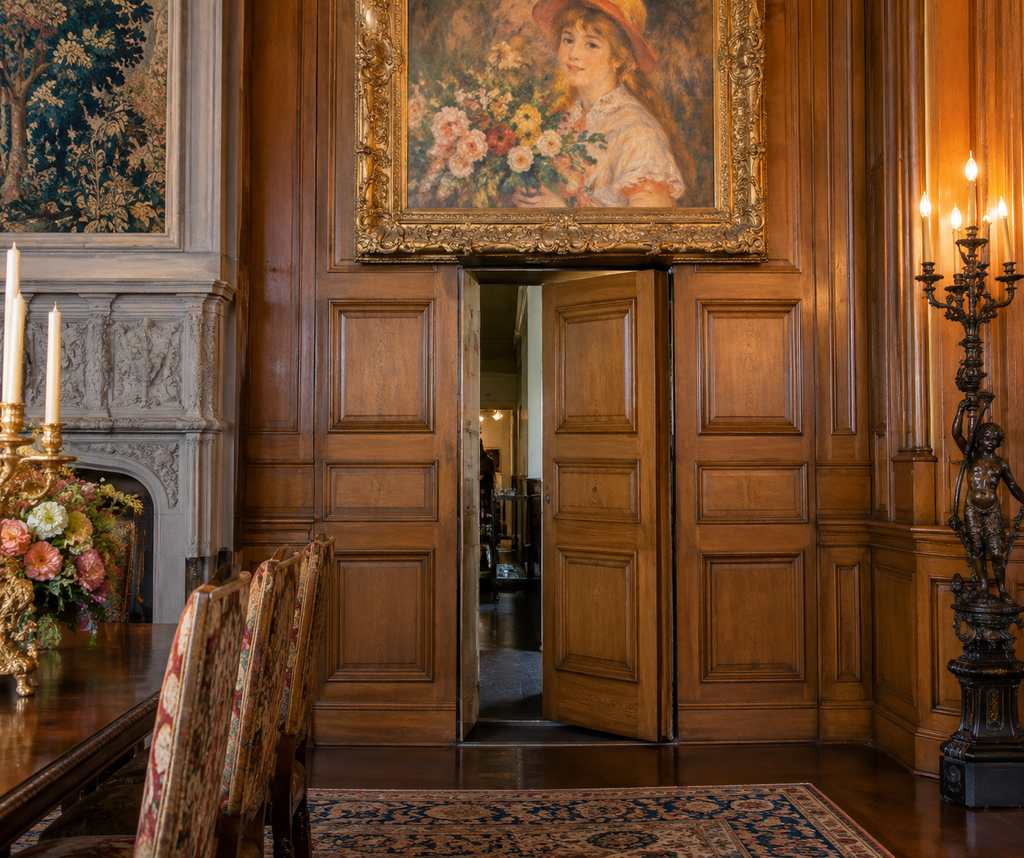
One of the best examples is hiding almost in plain sight in the Breakfast Room.
A Renoir portrait hangs above what appears to be ordinary wall paneling. Look beneath the painting, however, and there is a doorknob. The panel is actually a concealed entrance through which servants could bring hot meals into the room without disrupting its appearance. High in the Library, other concealed doors connect with a passageway leading to the Second Floor Living Hall. Even George Vanderbilt’s bedroom had concealed closet doors so that ordinary doorframes wouldn’t interrupt the room’s symmetry.
These weren’t gimmicks intended to mystify visitors. They tell us something about the way a great Gilded Age house functioned.
While family members and guests occupied the beautifully composed public rooms, another world was moving around them—cooks preparing meals, servants carrying trays, housekeepers tending rooms and other employees doing the work required to keep a 250-room house operating.
A Trapdoor With a Very Different Job Today
One concealed opening has an especially interesting second life.
In the Winter Garden, marble slabs cover a trapdoor that once allowed plants to be moved between the Conservatory area and the Winter Garden without disturbing guests. Early plans called for an elevator, but one was never installed; a ladder was used instead.
The trapdoor is still there.
Biltmore says it is rarely opened today, except during summer when it can provide ventilation for an employee break room below.
That small detail bridges more than a century of life at Biltmore. A hidden opening once used to help maintain the effortless appearance of Vanderbilt hospitality now occasionally helps make the working day a little more comfortable for Biltmore employees.
Visitors interested in the working side of the mansion can go considerably farther. Biltmore currently offers a Backstairs Tour through rarely seen domestic-staff areas, with stories about the people who lived and worked on the estate.
Once you know those concealed doors are there, it becomes harder to look at Biltmore’s grand rooms without wondering about the activity that once took place just beyond them.
👷 The Workers Behind the Vanderbilt Dream
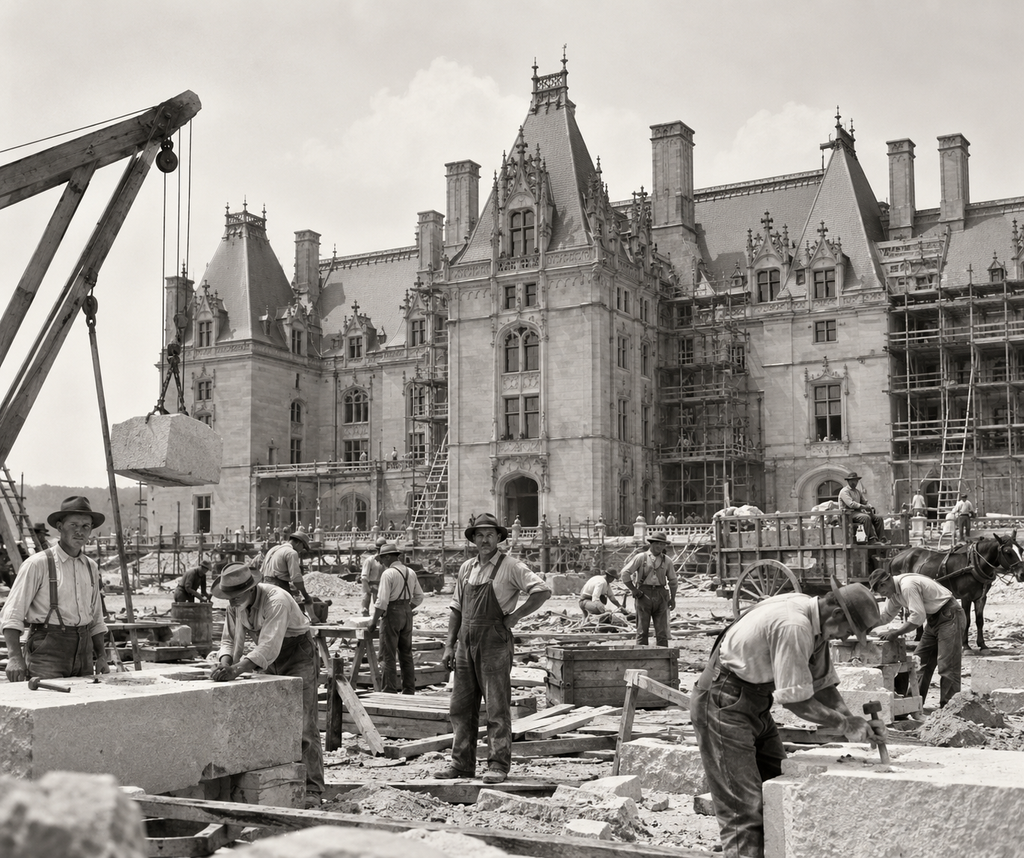
George Vanderbilt had the vision for Biltmore, but hundreds of people had to turn that vision into stone, wood, glass and landscape.
The workforce included local laborers as well as skilled blacksmiths, painters, carpenters and stonecarvers. Some specialized workers came from large cities and occasionally from abroad. Biltmore’s surviving records also show that race and class affected both the jobs workers held and what they were paid. An 1893 management letter indicates that African American employees actually outnumbered white employees at that time, although payroll records suggest that crews were often segregated and that many Black workers occupied lower-paid positions.
Their work was demanding. And sometimes they objected to the conditions.
Construction workers were normally expected to work about ten hours a day, six days a week. In 1892, carpenters asked to reduce their winter workday from ten hours to eight because daylight was becoming shorter.
Management’s answer wasn’t a shorter day.
They installed lights in the workshop.
Workers had better results on another issue. Construction could be dangerous, and employees successfully pressed for injured workers to receive half pay while recovering rather than losing their wages entirely.
These disputes complicate the polished story of Biltmore in an important way. The château may represent one man’s extraordinary vision, but its walls were raised by people whose names most visitors will never know.
Today, Biltmore is making more of those lives visible. An exhibit about the construction of Biltmore House is included in the basement portion of the self-guided tour, and the estate acknowledges that its continuing research represents only a small fraction of the enormous workforce that built the property.
A visitor looking at Biltmore’s carved stone can therefore see more than remarkable craftsmanship. It is also evidence of the people whose working lives became part of the house.
🖼️ The Priceless Secret Hidden Behind a Wall
By 1942, Biltmore was no longer simply a private family residence. It had been open to visitors since 1930.
That made what happened during World War II particularly remarkable.
As the United States entered the war, officials at the National Gallery of Art in Washington were concerned about protecting some of the nation’s most important works from the possibility of attack. National Gallery director David Finley knew Biltmore from an earlier visit and considered its remote location and fire-resistant construction suitable for safekeeping.
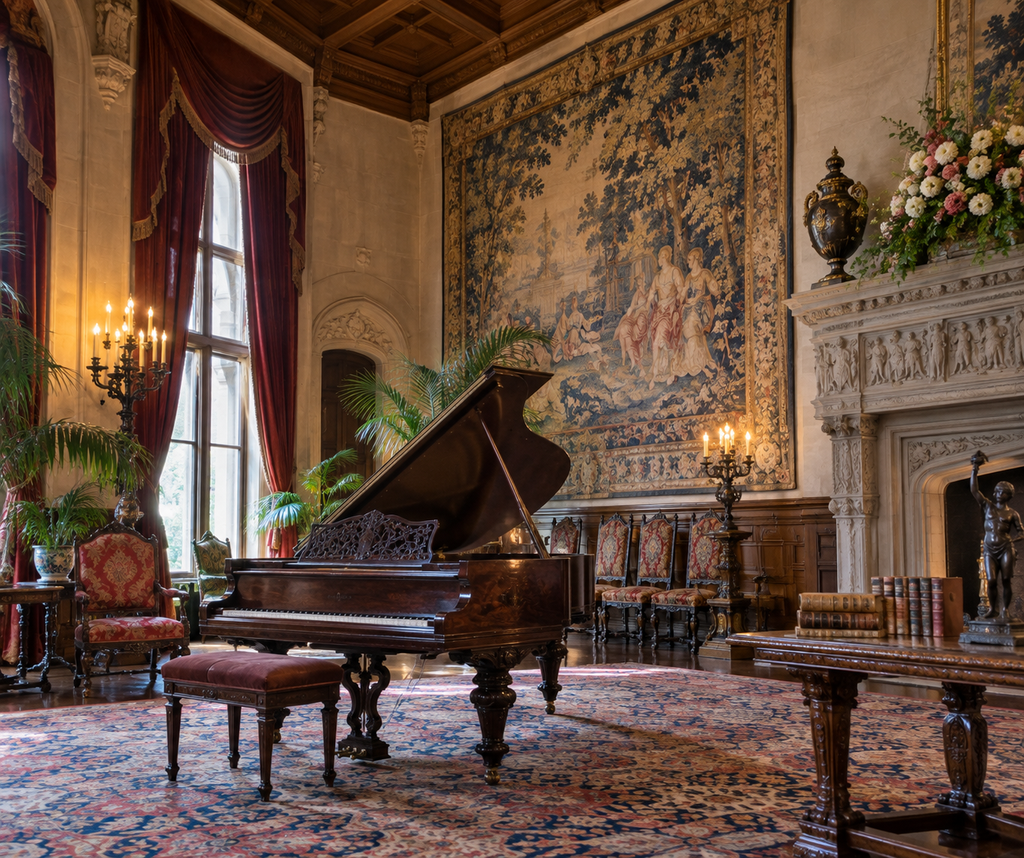
On January 8, 1942, 62 paintings and 17 sculptures arrived in Asheville under guard. The unfinished Music Room at Biltmore had been prepared with steel doors and other security measures to protect them. Among the works hidden there were Gilbert Stuart’s portrait of George Washington and a Rembrandt self-portrait.
But perhaps the most extraordinary part of the story is what was happening on the other side of the wall.
Biltmore remained open.
Visitors toured the house and walked past the Music Room without knowing that masterpieces from the National Gallery were concealed nearby under 24-hour armed guard. The works remained at Biltmore until 1944.
Imagine knowing that when you walk through the house today. Thousands of wartime visitors passed within a short distance of a secret collection they weren’t supposed to know existed.
Here the word secret really does apply.
👻 Do George and Edith Vanderbilt Still Wander Biltmore?
Old houses attract ghost stories, and a house as enormous and atmospheric as Biltmore has accumulated its share.
One of the most persistent legends centers on the Library and George Vanderbilt, whose love of books is well documented. The folklore says that a shadowy male figure has been seen there, sometimes associated with approaching storms. Other versions tell of a woman’s voice calling the name “George,” which storytellers have attributed to Edith Vanderbilt. Some accounts go further, claiming that voices or conversations have been heard when no one is there.
There are stories elsewhere in the house as well. The empty indoor swimming pool has inspired tales of unexplained splashing, laughter or voices, while other accounts attach apparitions to Biltmore’s basement rooms.
But here the distinction between history and folklore matters.
The stories are easy to find repeated on paranormal and travel websites, but reliable firsthand documentation is much harder to find. Accounts of the Library hauntings are generally repeated without named witnesses, dated incidents or surviving staff reports that would allow us to verify what happened.
So are George and Edith still wandering Biltmore?
History can’t answer that.
What we can say is that the ghost stories have become part of the folklore surrounding the house. And perhaps their persistence tells us something interesting in itself. Biltmore feels inseparable from the family who created it, and George Vanderbilt’s Library remains such a personal expression of him that it isn’t difficult to understand why later generations imagined its owner lingering among his books.
Visitors today can walk through that same Library and see the room around which the stories have grown.
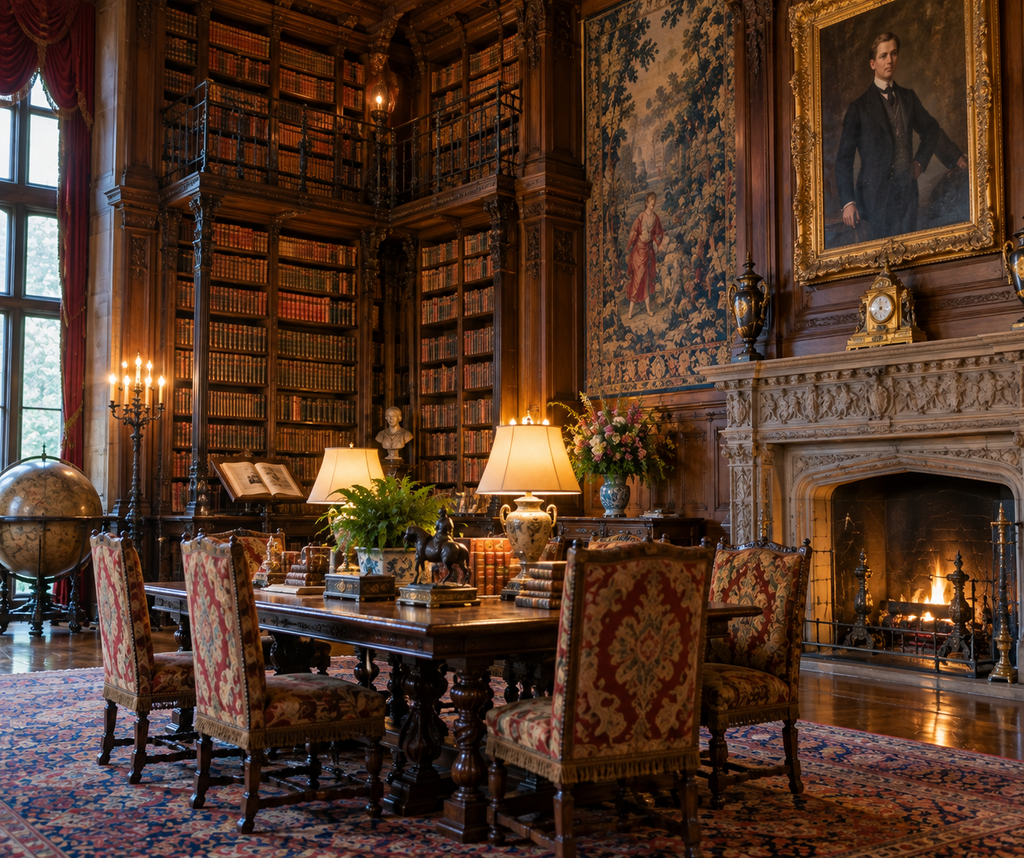
Whether anything else remains there is a question each visitor can answer for themselves.
🎭 The “Halloween Room” That Wasn’t About Halloween
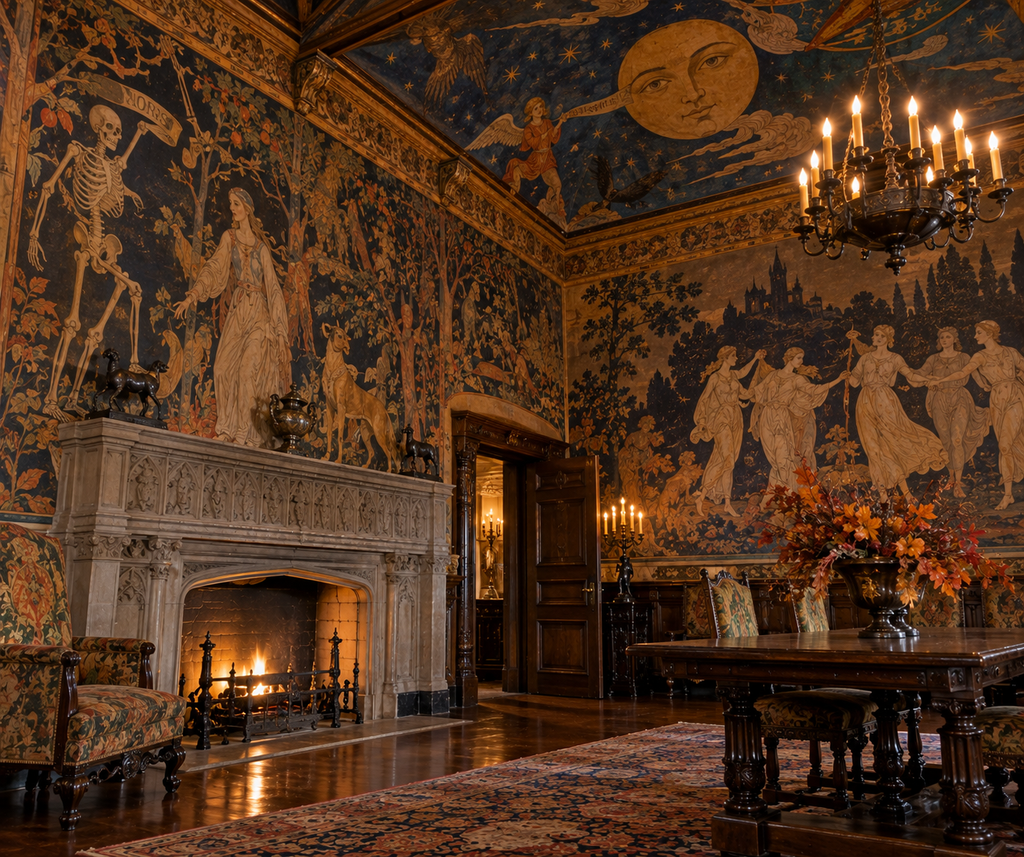
Down in Biltmore’s basement is a room covered with strange, colorful murals—witches, cats and other fanciful figures that helped give it the name Halloween Room.
That name invites a spooky explanation.
The real story is better.
The murals date to the 1920s and were connected with a party given by Cornelia Vanderbilt Cecil and her husband, John Cecil. The room’s unusual decoration eventually acquired its Halloween association, and over the years its appearance has helped inspire mystery and paranormal stories. But the room was not originally created as some secret chamber for the occult.
It was essentially the exuberant aftermath of people having a party.
That makes the room an excellent example of how legends grow at historic places. A later visitor encounters dark basement walls covered with strange figures, hears the name Halloween Room, and a much more sinister story almost writes itself.
Today the room is part of the basement area visitors encounter on Biltmore’s self-guided house tour, and it also contains an exhibition about the workers who constructed the estate.
The mystery hasn’t disappeared. It has simply changed. Instead of asking what terrible thing happened here?, the more interesting question may be how an old party room acquired an identity that its original decorators probably never imagined.
🚂 The Railroad That Disappeared
Building Biltmore presented an enormous logistical problem. Stone, brick, timber, equipment and people had to reach what was essentially a massive construction site in the mountains of western North Carolina.
Part of the answer was a railroad.
A temporary rail system helped transport materials and workers during construction. Photographs preserved by Biltmore show employees riding to the construction site and workers posing with a locomotive on the Esplanade.
And this is where one of the easily repeated Biltmore stories needs correcting.
The construction railroad sometimes gets transformed online into a romantic private railway carrying Vanderbilt’s fashionable guests directly to the mansion. The historical evidence instead points to something much more practical: this was infrastructure for building Biltmore and moving the people and materials required to do it.
Once its job was finished, the construction railroad disappeared.
That changes the experience of looking across Biltmore’s carefully landscaped grounds. The serene setting visitors encounter today was once crossed by the machinery and transportation needed to create it.
The finished estate was designed to make all that effort disappear.
Knowing it was once there allows us to put some of the noise and movement back into the story.
🍽️ A Mystery Hidden in the China Cabinet
Not every Biltmore mystery involves ghosts or hidden rooms.
For years, curators had a set of china whose origins they couldn’t satisfactorily explain. Because it had been used at a 1931 holiday gathering, it became known informally as the “Christmas china.” Because employees later used it, another theory connected it with the staff.
Neither nickname answered the basic question: What had it originally been for?
Biltmore’s Museum Services staff eventually investigated the pieces, following the evidence until they were able to resolve the mystery of the unidentified china.
It isn’t a dramatic mystery by mansion standards. No ghost appeared, no secret vault opened, and no scandal was uncovered.
But it reveals something fascinating about historic houses:
Their histories are not finished.
Objects lose their stories. Family memories become uncertain. Labels written generations later turn assumptions into apparent facts. Then an archivist finds a document or a curator notices a clue, and something everyone thought they understood has to be reconsidered.
That process continues at Biltmore today. Its oral-history program was originally established partly to preserve the memories of servants who had worked in Biltmore House; as those firsthand voices became harder to recover, the program expanded to preserve the experiences of later estate workers and Vanderbilt descendants.
There may still be stories inside Biltmore waiting for someone to recognize them.
🔍 Looking Beyond the Grand Rooms
Biltmore’s size makes it easy to concentrate on superlatives: the number of rooms, the acreage, the architecture, the art and the wealth required to create it.
The secrets tell a different story.
A concealed door introduces us to the employees moving quietly behind the family’s rooms. A labor dispute reminds us that the château was also a workplace. A sealed Music Room takes us into the uncertainty of World War II. An eerie basement room shows how easily history can turn into legend. And the ghost stories remind us that sometimes the stories people continue to tell about a place become part of its history too—even when we cannot prove that the stories themselves are true.
Perhaps that is the real secret of Biltmore.
The house everyone sees is only part of the story.
The rest is hiding behind doors, buried in archives, preserved in family memories, repeated as folklore—and sometimes waiting in plain sight for a curious visitor to ask one more question.e Biltmore Estate is more than just a historic landmark—it is a living piece of history, filled with stories waiting to be discovered. Whether you’re drawn to its ghostly legends, architectural wonders, or untold secrets, every corner of the estate has something to reveal.