The Legends, Mysteries, and Questions Visitors Still Ask Today:
Every historic home collects stories over time. Some begin with documented events and grow more elaborate with each retelling. Others emerge from former employees, devoted fans, tour guides, or visitors who notice something unusual and begin asking questions. Over the years, those stories become woven into the identity of a place, existing somewhere between history, memory, folklore, and speculation.
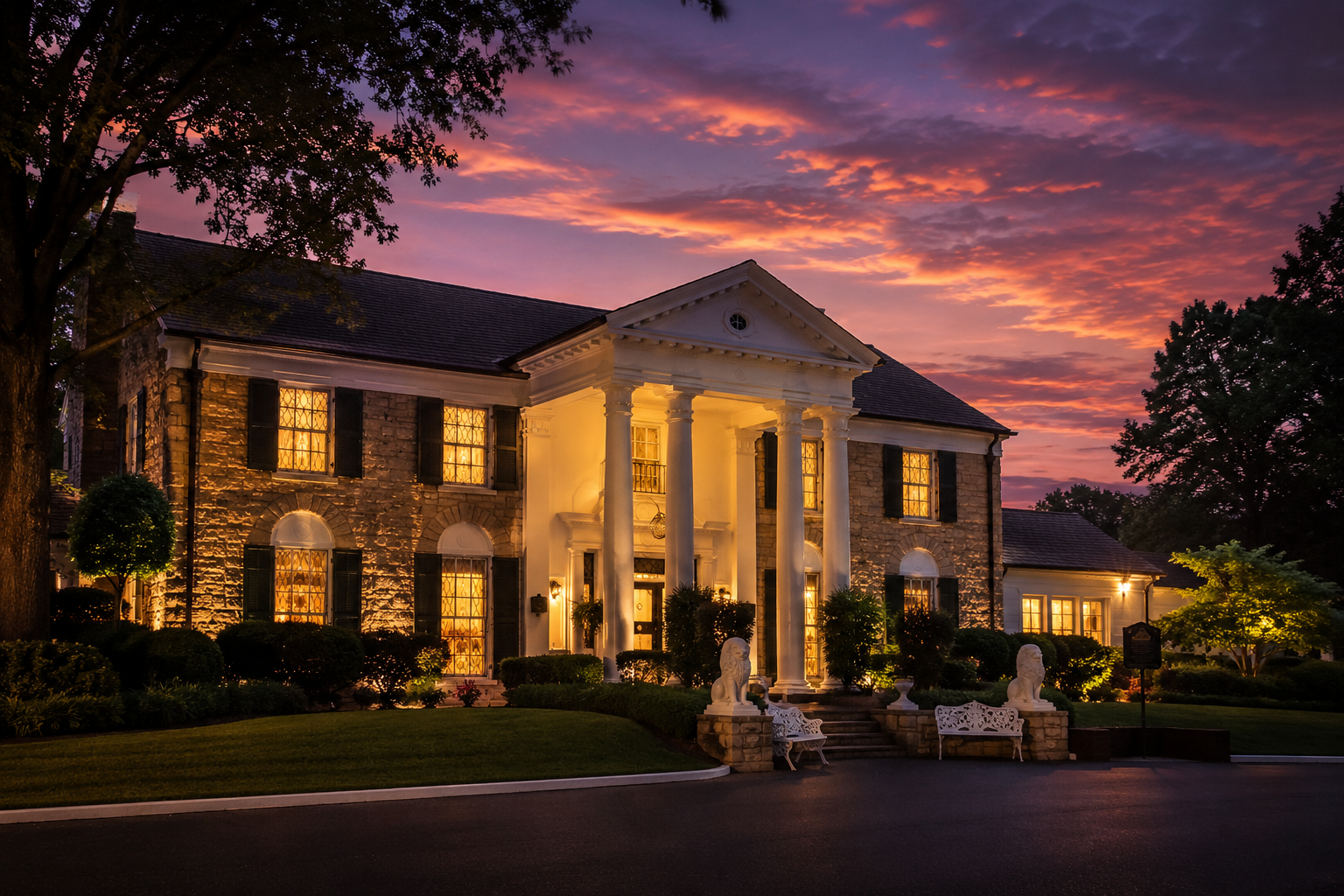
Few American homes have inspired more stories than Graceland. Part of that fascination comes from the man who lived there. Elvis Presley spent more than twenty years at Graceland, yet despite decades of books, documentaries, interviews, and tours, parts of his private world remain surprisingly elusive. Millions of visitors have walked through the mansion, studied its furnishings, and explored the grounds, but some of the most intriguing questions have never been fully answered.
As a result, Graceland has become a place where fact and legend often meet.
Some of the stories surrounding the mansion have a clear basis in history. Others rely on secondhand accounts, family recollections, or observations that have never been fully explained. A few have become so deeply woven into Graceland’s story that separating truth from rumor may be impossible. In many cases, the story itself has become part of the property’s history, and that uncertainty is part of what makes these tales so fascinating.
This article is not intended to prove or disprove every rumor. Instead, it explores some of the most persistent stories associated with Graceland—the questions visitors continue asking, the legends that refuse to disappear, and the mysteries that still spark conversation decades after Elvis last walked these halls.
Whether the stories are completely true, partly true, or simply the product of a good storyteller, they remain part of the Graceland experience.
🗝️ The House Still Keeps Its Secrets
For a mansion that has welcomed millions of visitors over the decades, Graceland still manages to keep a surprising number of secrets—or at least the appearance of them. Visitors tour the rooms, walk the grounds, and leave feeling they have seen the home that made Elvis Presley famous. Yet it is often the places they cannot enter and the questions that remain unanswered that linger longest in memory.
No mystery captures that feeling more completely than Graceland’s second floor.
The Forbidden Second Floor
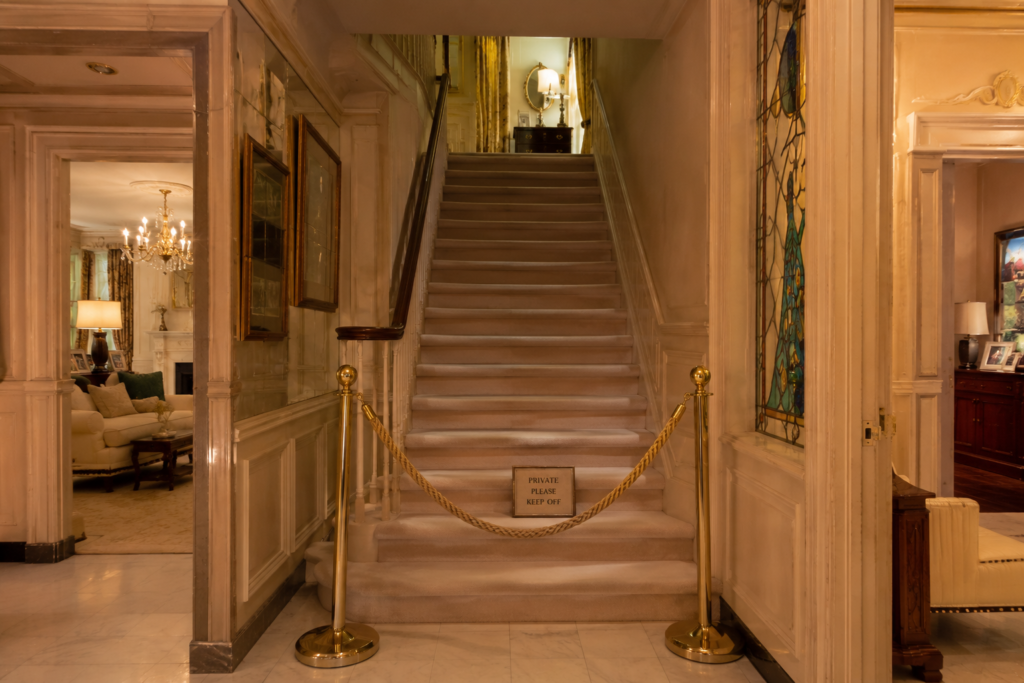
Of all the rooms, exhibits, and artifacts at Graceland, one of the most memorable features is not something visitors see at all. It is the staircase that rises from the main floor to the private second level of the mansion.
Nearly everyone notices it. Visitors pass the staircase as they move through the house and naturally glance upward. Yet unlike every other area on the tour route, this staircase remains off limits. No special ticket grants access. No guided tour ventures beyond the rope. The second floor has remained closed to the public since Graceland first opened as a museum.
That decision has fueled curiosity for decades.
In a world where celebrities often share every detail of their lives, the idea that part of Elvis Presley’s home remains private feels almost unusual. Millions of people have toured Graceland since it opened to the public in 1982, but none have been allowed upstairs. As a result, the staircase has become one of the most discussed locations in the mansion.
The mystery is not created by what visitors know. It is created by what they don’t.
Unlike some Graceland legends, the existence of the upstairs rooms is no mystery. Through photographs, floor plans, and accounts from those who knew Elvis, we have a general understanding of what occupies the second floor. The private living quarters included Elvis’s bedroom, dressing area, bathroom, office, and guest rooms. This was the most personal part of the house—the place where he could retreat from business, visitors, and even members of his inner circle.
Because the rooms remain inaccessible to visitors, stories about them have naturally taken on an almost legendary quality. Some imagine rooms frozen in time exactly as they appeared in August 1977. Others envision hidden collections of personal belongings, private keepsakes, or undiscovered corners of the mansion that have never been revealed to the public.
The reality is likely far less dramatic. Yet the lack of access continues to make the second floor one of the most intriguing parts of Graceland.
Who Really Goes Upstairs Today?
One of the most persistent Graceland myths is that nobody has entered the second floor since Elvis died.
It is an appealing story. The image of untouched rooms preserved exactly as they were on Elvis’s final day has fueled countless conversations among fans and visitors over the years. Some even imagine decades of dust quietly accumulating behind closed doors.
The truth appears to be more complicated.
While the second floor remains closed to the public, it has not been abandoned. Historic homes require ongoing preservation, and Graceland is no exception. Preservation staff, archivists, family members, and a small number of trusted individuals have reportedly accessed the area over the years as part of maintaining and protecting the property.
Rather than existing as an untouched time capsule, the upstairs occupies a unique middle ground. It is not a museum exhibit, yet it is not simply another part of a private residence. It remains a carefully protected space within one of America’s most visited historic homes.
For many visitors, that reality is every bit as fascinating as the rumors.
Why Keep It Closed?
The question naturally follows: if the rooms still exist and are occasionally accessed, why not open them to the public?
According to those responsible for preserving Graceland, the answer has always centered on respect and privacy. The second floor was Elvis’s most private space. It was where he slept, read, relaxed, and spent time away from public attention. It was also where his life came to an end.
Opening those rooms would undoubtedly satisfy public curiosity. Yet doing so would permanently change something that has become increasingly rare in the world of celebrity tourism—a boundary.
In a mansion visited by hundreds of thousands of people every year, the second floor remains one of the few places that still belongs to Elvis. Whether visitors view that decision as privacy, preservation, or simply part of the legend, it has transformed an ordinary staircase into one of the most enduring mysteries in American popular culture.
🌴 The Jungle Room and Other Unusual Spaces
Few rooms at Graceland generate stronger reactions than the Jungle Room.
Some visitors love it immediately. Others stare at the carved wood furniture, green shag carpeting, and stone waterfall and wonder what they are looking at. Decades after it was created, the room remains one of the most recognizable spaces in the mansion—and one of the most misunderstood. Like many parts of Graceland, the Jungle Room has accumulated its own collection of stories over the years.
The Room That Became a Recording Studio
One of the most persistent stories surrounding the Jungle Room begins with a furniture store in Memphis.
According to a longtime Graceland tale, Vernon Presley once remarked that he had seen some of the ugliest furniture imaginable at a local showroom. Rather than being discouraged, Elvis was reportedly intrigued. As the story goes, he purchased the entire Polynesian-inspired furniture display, transforming part of Graceland into the unusual space visitors see today.
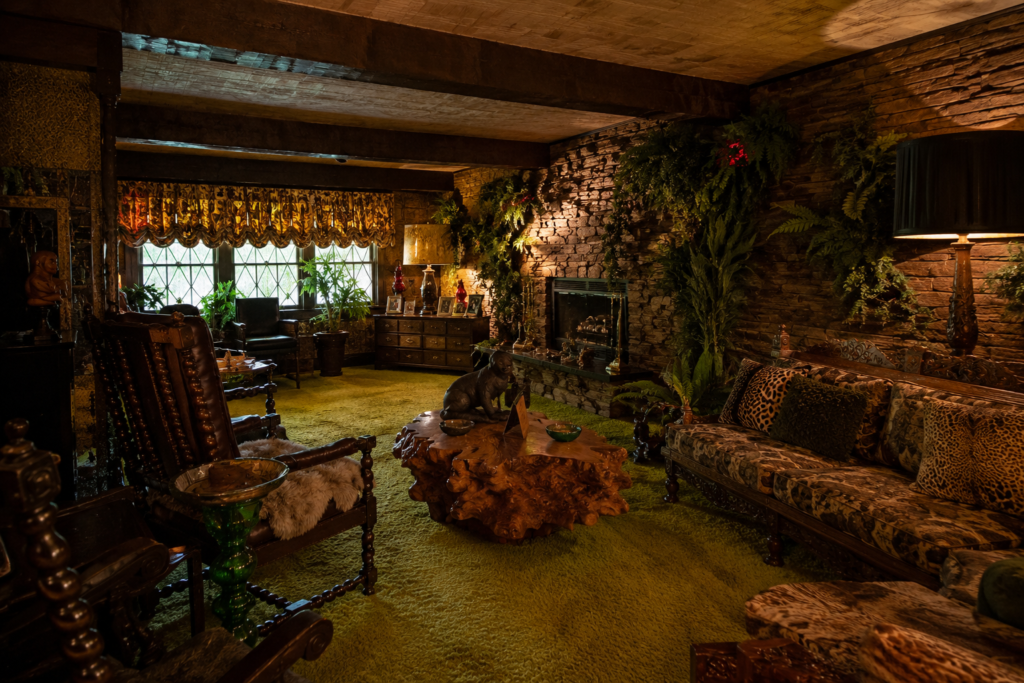
Whether every detail of the story is accurate or not, the room certainly reflected Elvis’s willingness to ignore convention and decorate according to his own tastes.
The feature that attracts the most attention today may actually have served a practical purpose. Thick green shag carpeting covers not only the floor but also portions of the walls and ceiling. While many visitors assume it was simply an over-the-top design choice from the 1970s, the heavy carpeting also helped absorb sound.
That unexpected benefit became important in 1976, when Elvis grew reluctant to travel to traditional recording studios. Rather than bringing Elvis to the studio, RCA brought a mobile recording unit directly to Graceland. The Jungle Room was transformed into a temporary recording space, with musicians and equipment filling the room. Several of Elvis’s final recordings were completed there, including tracks that later appeared on Moody Blue.
For a room often remembered for its unusual décor, its greatest significance may actually be musical.
Why the Jungle Room Still Divides Visitors
Part of what makes the Jungle Room so fascinating is that people rarely react to it the same way.
Some view it as an example of Elvis’s creativity and willingness to ignore trends. Others see it as a perfect snapshot of 1970s design excess. Either way, few visitors walk through the room without forming a strong opinion, and the stories surrounding the room only add to its reputation.
One long-running tale involves the room’s stone waterfall feature. According to various accounts, construction challenges and water issues occasionally created headaches for the Presley family. Some versions of the story even describe electrical problems and a small fire that allegedly required quick action to prevent more serious damage. As with many Graceland stories, the details vary depending on the source.
Visitors also tend to overlook another curious feature hidden among the oversized wooden furnishings. Several pieces reportedly contained built-in electronics, including stereo equipment and record storage concealed within the carved cabinetry. The room was designed not simply as a conversation piece, but as a place where Elvis could relax, listen to music, and spend time with friends.
Perhaps the most surprising detail is that Elvis himself apparently never referred to the space as the “Jungle Room.” According to those close to him, it was simply known as “the den.” The nickname that has become famous around the world appears to have emerged later, after Graceland opened to the public.
That detail may be fitting, because the room has taken on a life of its own over the years. It has evolved from a private gathering place into one of the most recognizable spaces in American popular culture. Whether visitors see it as eccentric, unforgettable, or somewhere in between, the Jungle Room remains one of the places where Graceland’s history, personality, and mythology all meet.
🌙 Life Inside Elvis’s Private World
The stories surrounding Graceland are not limited to hidden spaces and architectural mysteries. Some of the most fascinating tales come from the way Elvis Presley actually lived inside the mansion.
By the 1970s, Graceland had become more than a home. It was a private world operating on its own schedule, shaped by the unusual realities of fame. Friends, family members, employees, and members of the “Memphis Mafia” often found themselves adapting to routines that seemed completely backward to everyone else.
For Elvis, normal hours were often optional.
The Mansion That Slept By Day
One of the most consistent accounts from people who knew Elvis is that he lived largely at night.
While most of Memphis was settling in for the evening, Elvis was often just beginning his day. He frequently slept through much of the afternoon, waking in the late afternoon or early evening and remaining active until the early morning hours. As a result, Graceland developed a rhythm unlike most households.
Meals were served at unusual times. Conversations stretched long into the night. Friends arrived after dark and stayed until sunrise. Entire outings were sometimes organized in the middle of the night simply because Elvis preferred to avoid crowds and public attention. Movie theaters were rented after hours. Amusement parks occasionally opened privately for late-night visits. Even simple activities often happened when most people were asleep.
The unusual schedule also contributed to some of Graceland’s most famous stories.
In 1976, a young musician named Bruce Springsteen arrived at Graceland in the middle of the night hoping to meet his musical hero. According to the story, Springsteen climbed over the front wall and made his way toward the mansion before security intercepted him. Elvis was reportedly away from the property at the time, but the story has become one of the most famous examples of Graceland’s almost mythical pull on musicians and fans alike.
Another memorable late-night encounter involved fellow rock-and-roll pioneer Jerry Lee Lewis. According to accounts from the period, Lewis arrived at Graceland’s gates carrying a firearm and demanding to see Elvis. The incident ended with police involvement and generated headlines across the country, further adding to Graceland’s growing collection of legends.
Whether entirely accurate in every detail or polished by years of retelling, these stories share a common theme: Graceland was rarely an ordinary home. Even routine evenings could become part of Elvis lore.
The Three Television Wall
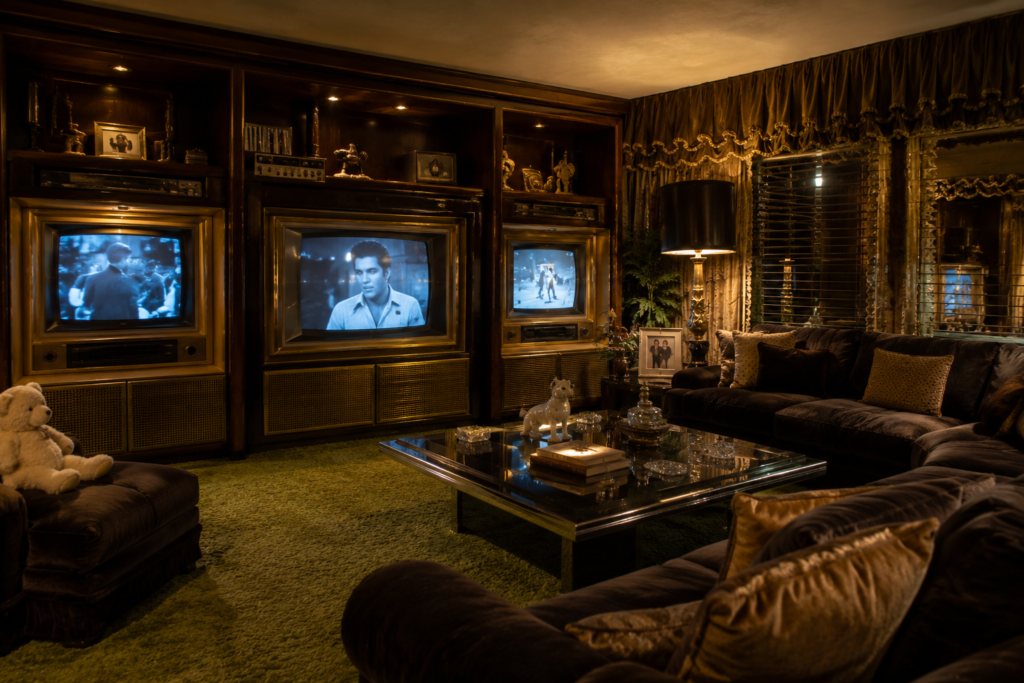
Visitors touring Graceland today often pause when they reach the television room in the basement.
Mounted side by side are three television sets, creating one of the mansion’s most recognizable and unusual features. For modern visitors accustomed to multiple screens, the arrangement may not seem particularly remarkable. In the 1970s, however, it was anything but ordinary.
According to those who knew Elvis, the idea reportedly came from President Lyndon Johnson, who was known for monitoring several television networks simultaneously. Elvis liked the concept and incorporated it into Graceland.
Over time, the three televisions became one of the most discussed features of the house. Some stories claim Elvis watched multiple programs at once. Others suggest he simply enjoyed having options available at any given moment.
One particularly colorful legend claims that if he disliked what appeared on the screen, he occasionally responded by shooting the television. Whether every version of the story is accurate is difficult to determine, but examples of bullet damage in televisions associated with Elvis have certainly helped keep the tale alive.
Like so many Graceland stories, the television wall sits comfortably between documented history and popular legend.
The Kitchen That Never Closed
If Graceland operated around the clock, the kitchen often did as well.
Friends and family members frequently recalled that food was available at almost any hour. Elvis’s unpredictable schedule meant that meals could be requested late at night, early in the morning, or seemingly anytime in between.
Over the years, stories about Elvis’s favorite foods have become nearly as famous as the mansion itself. Peanut butter and banana sandwiches, Southern comfort food, hamburgers, and homemade desserts all appear regularly in recollections from those who spent time at Graceland.
The kitchen became the center of countless late-night conversations, informal gatherings, and unexpected meals.
Many visitors are surprised to learn that one of Graceland’s most enduring stories involves something as simple as a sandwich. According to a frequently repeated account, Elvis once flew to Denver with friends simply to enjoy a Fool’s Gold Loaf sandwich before returning home.
Whether every detail of the story unfolded exactly as remembered, it perfectly captures the larger image people have of life at Graceland—spontaneous, unconventional, and often larger than life.
Taken together, the television room, the kitchen, and the mansion’s nocturnal schedule reveal a side of Graceland that visitors do not always see on the tour. Beyond the exhibits and historic rooms was a home shaped by the habits, preferences, and personality of the man who lived there.
📰 The Day Graceland Nearly Went Up for Auction
For decades, many Graceland stories have existed somewhere between fact and folklore. Then, in 2024, a headline appeared that sounded like another unbelievable rumor: Graceland was headed for a public auction.
The claim centered on allegations that Lisa Marie Presley had used the property as collateral for an unpaid loan. News of the proposed sale spread quickly, leaving fans around the world stunned. For a brief period, one of America’s most famous homes appeared to be facing an uncertain future.
The story soon took another unexpected turn. Court challenges halted the auction, and investigators later concluded that the entire claim was part of an elaborate fraud scheme. What began as a shocking headline ultimately became a criminal case rather than a real threat to the property.
Unlike many Graceland legends, this story was not built on rumor. Yet its twists and turns felt every bit as unbelievable as some of the mansion’s most famous myths. For a few days, Graceland found itself at the center of a mystery that was very real—and one that quickly became another chapter in the property’s remarkable story.
🚶➡️ As You Travel On
Historic homes often preserve more than architecture and artifacts. They preserve stories.
Some of those stories can be documented through photographs, newspaper accounts, and firsthand recollections. Others exist in a less certain space, passed from one visitor to another, growing a little larger or a little more mysterious with each retelling. Graceland has accumulated both.
Perhaps that should not be surprising. Few homes have been studied as closely as Graceland, and few public figures continue to inspire the level of curiosity that surrounds Elvis Presley. Millions of visitors have walked through the mansion, yet many leave talking about the things they could not see—the staircase leading to the second floor, the rumors of hidden spaces, the stories connected to the Jungle Room, or the unusual routines that shaped daily life behind the gates.
Some of the questions explored in this article have straightforward answers. Others remain open to interpretation. A few may never be fully resolved. Yet that uncertainty is part of what keeps the stories alive.
In many ways, Graceland is more than a historic home. It is a place where history, memory, and legend continue to overlap. Visitors come to see the rooms where Elvis lived, but they often leave thinking about the stories that still surround them.
Whether those stories are completely true, partly true, or simply the product of a good storyteller, they have become part of the Graceland experience. Decades after Elvis last walked these halls, people are still asking questions, still sharing stories, and still searching for answers.
And perhaps that is the greatest Graceland mystery of all.