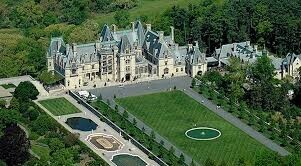
A Gilded Age vision set against the mountains of western North Carolina
Setting the Scene
Rising above the wooded hills outside Asheville, North Carolina, Biltmore Estate seems at first glance like something transported from another place and another age. Its steep roofs, stone towers, elaborate carvings, and enormous scale evoke the great châteaux of France rather than a private American home. Yet Biltmore is distinctly American.
Completed in 1895 for George Washington Vanderbilt, the 250-room house was the centerpiece of an extraordinary experiment in architecture, landscape design, forestry, farming, and estate life. Vanderbilt did not simply set out to build an impressive mansion. He envisioned an entire estate—one where art, books, architecture, nature, and modern innovation could exist together. More than a century later, Biltmore remains the largest privately owned house in the United States. But its size is only part of its story.
To understand Biltmore, it helps to look beyond the numbers and imagine what George Vanderbilt was trying to create in the mountains of North Carolina.
📜 A Brief History of the Biltmore Estate
George Washington Vanderbilt was the youngest son of William Henry Vanderbilt and grandson of Cornelius Vanderbilt, whose railroad and shipping fortune made the family one of the wealthiest in America. Unlike some members of his famous family, George was known for being relatively private and intellectual. He loved books, art, travel, and the countryside, and during visits to western North Carolina he became captivated by the Blue Ridge Mountains surrounding Asheville.
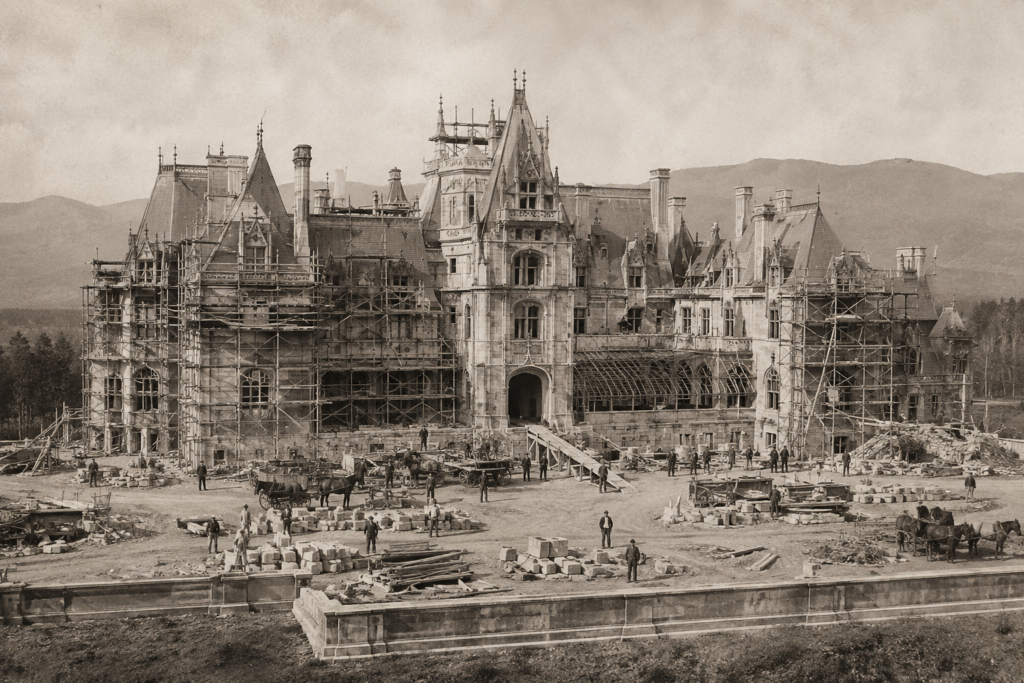
In 1888, Vanderbilt began purchasing land in the area. Eventually, his holdings would encompass approximately 125,000 acres. For the house itself, Vanderbilt turned to one of America’s most prominent architects, Richard Morris Hunt. Hunt drew inspiration from the grand French Renaissance châteaux Vanderbilt had seen during his travels in Europe. Construction began in 1889. It was an enormous undertaking. Craftsmen, laborers, architects, landscape designers, and engineers worked for six years to transform Vanderbilt’s mountain property into an estate unlike anything else in America. On Christmas Eve 1895, George Vanderbilt officially opened Biltmore House to family and friends.
The estate was not entirely finished, but Vanderbilt’s remarkable vision had become a home.
🏠 Architecture & Design Highlights
The sheer scale of Biltmore House is difficult to appreciate until you begin looking at the details. The Châteauesque exterior rises dramatically from the surrounding landscape, with steeply pitched roofs, towers, ornate stone carvings, gargoyles, arches, and elaborate architectural decoration.
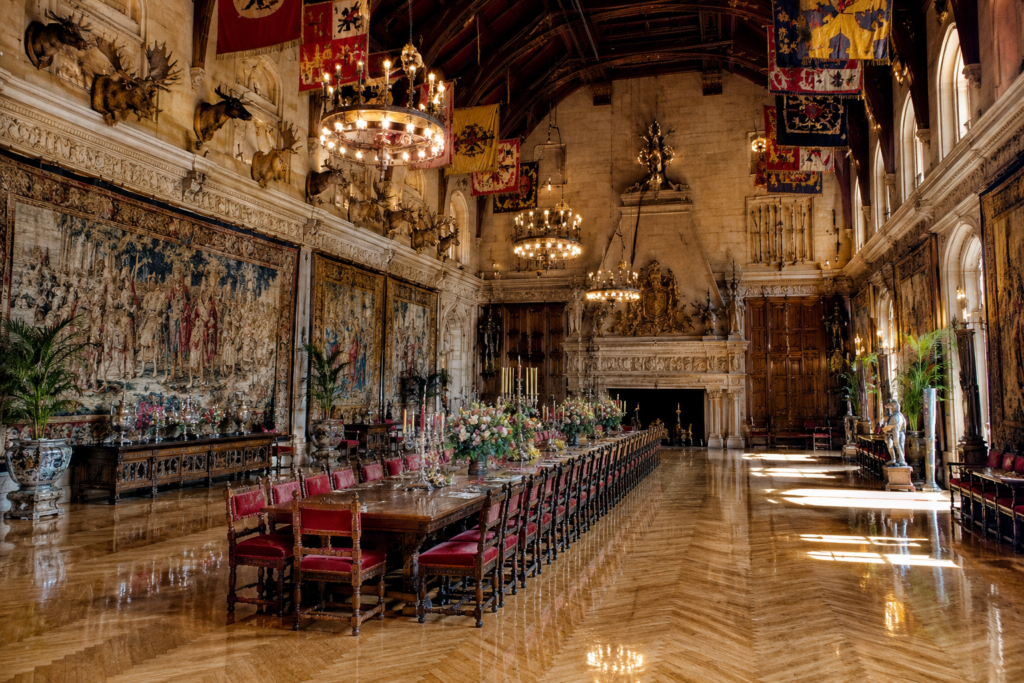
Inside, the house contains approximately 250 rooms. The Banquet Hall is among the most dramatic, with a soaring ceiling, massive fireplaces, Flemish tapestries, and enough space to entertain on a scale few private homes could accommodate. But Biltmore was designed for more than spectacle.
George Vanderbilt’s personal library contained thousands of books, reflecting a lifelong passion for reading and learning. The Winter Garden brought light and greenery into the center of the house beneath an expansive glass roof. Elsewhere were bedrooms for family members and guests, sitting rooms, servant spaces, kitchens, storage rooms, and recreational areas. Even the basement reflected Vanderbilt’s desire to create something extraordinary. It included an indoor swimming pool, bowling alley, and gymnasium—features that would have been remarkable in a private residence at the end of the nineteenth century.
Biltmore was designed to look back toward European architectural traditions while quietly incorporating some of the most modern technology available in America.
👤 The People Behind the Biltmore Estate
Biltmore may have been George Vanderbilt’s vision, but creating it required several of the most influential designers of the era.
Architect Richard Morris Hunt designed the house. Already celebrated for his work on grand residences and public buildings, Hunt helped translate Vanderbilt’s admiration for European architecture into an American country estate. The landscape surrounding the house was entrusted to Frederick Law Olmsted, the landscape architect best known for designing New York City’s Central Park. Olmsted faced a difficult challenge. Much of the land Vanderbilt purchased had been damaged by farming, logging, and erosion.
Rather than simply creating ornamental gardens around the mansion, Olmsted approached the property as an entire landscape. Formal gardens would surround the house, while forests, farmland, roads, and distant mountain views would become part of the larger design. Another important figure was Gifford Pinchot, who helped develop an early scientific forestry program on the estate before later becoming the first chief of the United States Forest Service. Together, Vanderbilt, Hunt, Olmsted, Pinchot, and the many people who worked on the property created something much larger than a mansion. hey created a working estate.
🌿 Life on the Estate
Although photographs of Biltmore often focus on the grandeur of the house, daily life there depended upon an extensive network of people and activities. George Vanderbilt married Edith Stuyvesant Dresser in 1898, and Biltmore became their family home. Their daughter, Cornelia, was born there in 1900. he Vanderbilts entertained family members and guests, but behind those elegant gatherings was a large staff responsible for keeping the estate functioning.
Cooks prepared meals in the kitchens. Housekeepers maintained hundreds of rooms. Gardeners cared for the formal landscapes. Stable workers tended horses. Farmers, foresters, craftsmen, and laborers worked throughout the enormous property. Biltmore was essentially a small community. The estate also reflected George Vanderbilt’s interest in agriculture and forestry. Land surrounding the house was used for farming, livestock, gardens, and forest management. That combination of private residence, working estate, and carefully managed landscape made Biltmore different from a mansion built simply to display wealth. It was intended to function.
🔄 The Biltmore Estate Today
The world that created Biltmore changed dramatically during the twentieth century. George Vanderbilt died unexpectedly in 1914 at the age of 51. Edith Vanderbilt and later generations of the family faced the challenge of maintaining an estate whose enormous scale made it increasingly difficult and expensive to operate. Portions of the original property were eventually sold. Much of that land became part of Pisgah National Forest, preserving an important connection between Biltmore’s early forestry experiments and the conservation of the surrounding mountains. In 1930, during the Great Depression, the family opened Biltmore House to the public. That decision helped transform the estate from a private family residence into one of America’s best-known historic destinations.
Today, Biltmore remains privately owned by descendants of George Vanderbilt. The estate has continued to evolve, incorporating historic preservation with gardens, agriculture, a winery, lodging, dining, and other visitor experiences. Yet the house remains at the center of it all—the physical expression of the vision that began more than 130 years ago.
🗺️ The Biltmore Experience
Visiting Biltmore is different from touring a historic house that occupies a single city block. The estate is large enough that the house, gardens, Antler Hill Village, winery, restaurants, and surrounding landscape can easily turn a visit into a substantial part of the day. The experience also changes with the seasons. Spring brings the gardens into bloom, autumn frames the estate in Blue Ridge color, and the Christmas season transforms the house with elaborate decorations and evening events. A visit to Biltmore also pairs naturally with Asheville and the historic and scenic attractions of western North Carolina, making the estate an easy centerpiece for a longer stay in the region.
📌 Why Biltmore Still Matters
It would be easy to dismiss Biltmore as simply an extravagant monument to Gilded Age wealth.
But that overlooks much of what makes the estate significant. Biltmore brought together some of the most influential ideas of its era—architecture inspired by Europe, technological innovation, landscape design, scientific forestry, agriculture, art, literature, and the complicated social structure required to operate a great country estate.
It also represents a period when extraordinary private fortunes were reshaping the American landscape. Some Gilded Age mansions disappeared. Others survived as museums, hotels, schools, or institutions. Biltmore followed a different path.
More than 130 years after George Vanderbilt welcomed his first guests, the estate remains in the Vanderbilt family and continues to operate as both a historic property and a living enterprise. That continuity may be one of the most remarkable parts of the Biltmore story.
🧭 Looking Back (and Forward)
Perhaps the most memorable thing about Biltmore is not that it has 250 rooms or that it remains America’s largest privately owned home. It is the scale of the idea behind it.
George Vanderbilt imagined a place where architecture, art, books, gardens, forests, agriculture, and mountain scenery could become parts of a single experience. Richard Morris Hunt gave that vision architectural form. Frederick Law Olmsted shaped the landscape around it. Generations of workers and family members kept it functioning. And more than a century later, visitors can still walk through the rooms and landscapes they created.
Biltmore offers a glimpse into the extraordinary wealth of the Gilded Age, but it also tells a larger story about ambition, preservation, family, and what happens to a great estate after the world that created it has disappeared. The house may be what draws visitors through the gates. The stories behind it are what make Biltmore worth remembering.