Crazy Horse Memorial: The Story, Vision, and Meaning Behind the Mountain
🌄 Setting the Scene
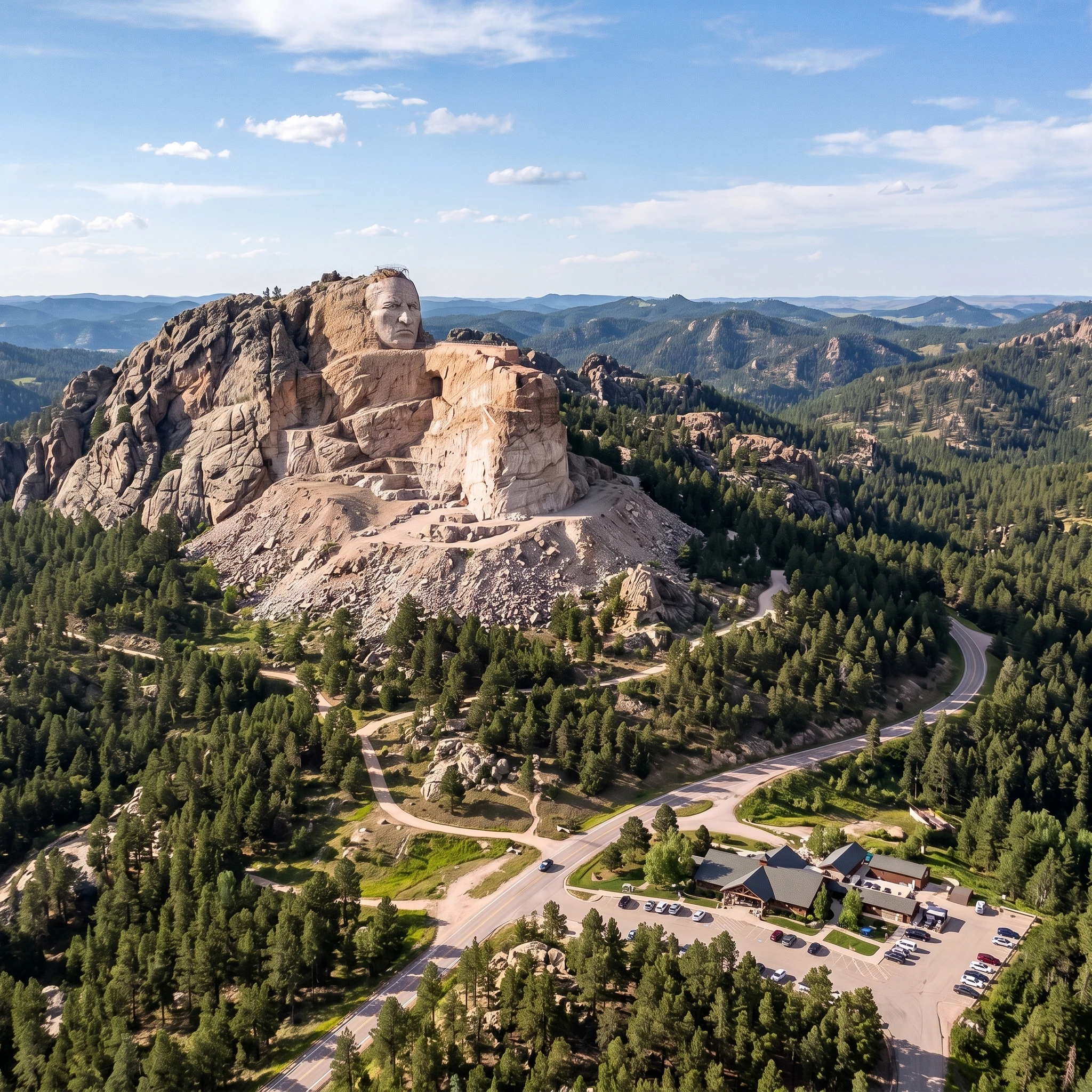
In the Black Hills of South Dakota, a face emerges from the side of a granite mountain. It is unmistakably human, yet everything about it seems almost impossibly large. Below and around it, much of the mountain remains rough and unfinished, making it possible to see not only what has already been created, but the enormous amount of work that still lies ahead.
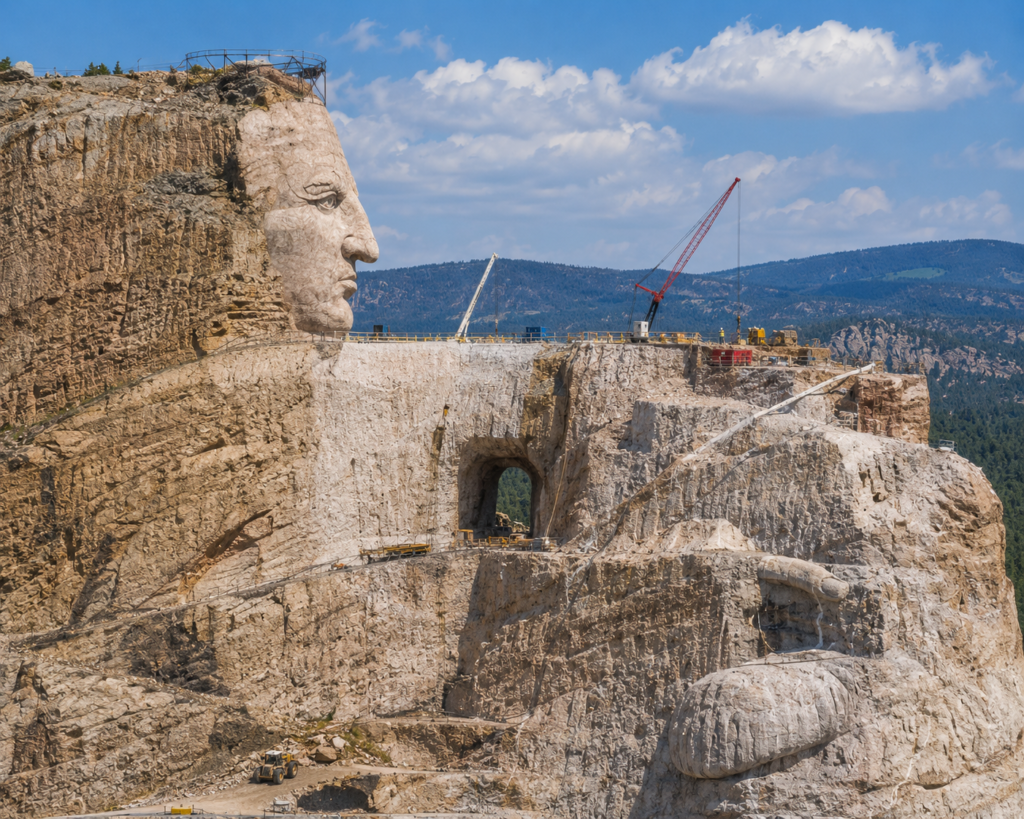
This is Crazy Horse Memorial, a mountain carving that has been taking shape since the first blast of rock in 1948. Unlike most historic landmarks, it cannot be understood simply by looking at what stands there today. The finished vision is much larger: Crazy Horse seated on horseback, his arm extended across the mountain. If completed as designed, the sculpture will measure 563 feet high and 641 feet long, with an outstretched arm stretching 263 feet across the granite. Even the face alone is 87½ feet high.
But perhaps the most remarkable thing about Crazy Horse Memorial is not its size. It is that the story is still being written into the mountain.
More than three-quarters of a century after work began, carving continues. Crews still drill, cut, measure and remove granite, gradually transforming the mountain according to a vision conceived generations ago. Visitors today are not simply seeing a monument; they are seeing one moment in a project that began before many of them were born and may continue well beyond their lifetimes.
That unfinished quality makes Crazy Horse different from nearly every other landmark in America. It raises questions almost immediately. Who imagined something on this scale? Why Crazy Horse? Why here, in the Black Hills? And why has the work continued for so many decades?
The answers lead far beyond the mechanics of carving a mountain. They lead to Lakota leader Henry Standing Bear, sculptor Korczak Ziolkowski, the history and meaning of the Black Hills, and an ambitious idea intended to honor the Native peoples of North America.
They also lead to more complicated questions about what a memorial can mean—and whether everyone sees that meaning in quite the same way.
Crazy Horse Memorial is therefore more than a colossal sculpture waiting to be finished. It is a monument still taking shape, and a story whose meaning continues to take shape with it.
📜 The Dream Behind Crazy Horse Memorial
The story of Crazy Horse Memorial did not begin with a sculptor looking for a mountain. It began with Lakota leader Henry Standing Bear and his determination that Native American heroes deserved to be remembered on a monumental scale.
By the 1930s, Mount Rushmore was already taking shape in the Black Hills. Its enormous presidential faces were becoming symbols of the nation, but Standing Bear saw another story that deserved to be told. He envisioned a memorial honoring Native Americans and chose Crazy Horse, the Oglala Lakota leader who had resisted efforts to force his people from their lands and onto reservations.
For Standing Bear, the location mattered as much as the man being honored. He believed the memorial belonged in the Black Hills, or Paha Sapa, a place of profound spiritual and cultural importance to the Lakota people. At one point, he even approached Mount Rushmore sculptor Gutzon Borglum about adding a Native American figure to that monument. When that did not happen, Standing Bear continued searching for another way to bring his vision to life.
That search eventually led him to Korczak Ziolkowski, a Polish-American sculptor who had briefly worked with Borglum at Mount Rushmore in 1939 and had recently attracted national attention after winning a sculpture prize at the New York World’s Fair. Standing Bear began corresponding with Ziolkowski that same year, inviting him to create a memorial that would tell a very different story in the same Black Hills.
World War II delayed those plans. Ziolkowski volunteered for military service, landed at Omaha Beach during the Normandy invasion and was later wounded. After the war, he turned down opportunities to create war memorials in Europe and instead returned to the idea Standing Bear had presented years earlier. In 1947, at age 38, he moved to the Black Hills to begin what would become the work of the rest of his life.
Standing Bear and Ziolkowski had selected Thunderhead Mountain, where the plan grew far beyond the relatively modest carving originally envisioned. Ziolkowski ultimately designed a massive sculpture showing Crazy Horse on horseback, his arm extended over the horse’s head.
On June 3, 1948, the project was formally dedicated. Five survivors of the Battle of the Little Bighorn were among those present when the first blast removed about ten tons of rock from the mountain.
From the beginning, however, the vision extended beyond the granite. The founders saw the mountain carving as part of a much larger educational and cultural mission devoted to preserving and sharing Native American history, cultures and traditions. That broader purpose would eventually lead to museums, educational programs and a university initiative alongside the carving itself.
And that distinction may be one of the most important things to understand about Crazy Horse Memorial. The mountain is enormous, but the original dream was larger than the mountain.
It was a dream that would also prove far more complicated than anyone standing beneath Thunderhead Mountain in 1948 could have imagined.
🔨 Carving a Mountain — One Blast at a Time
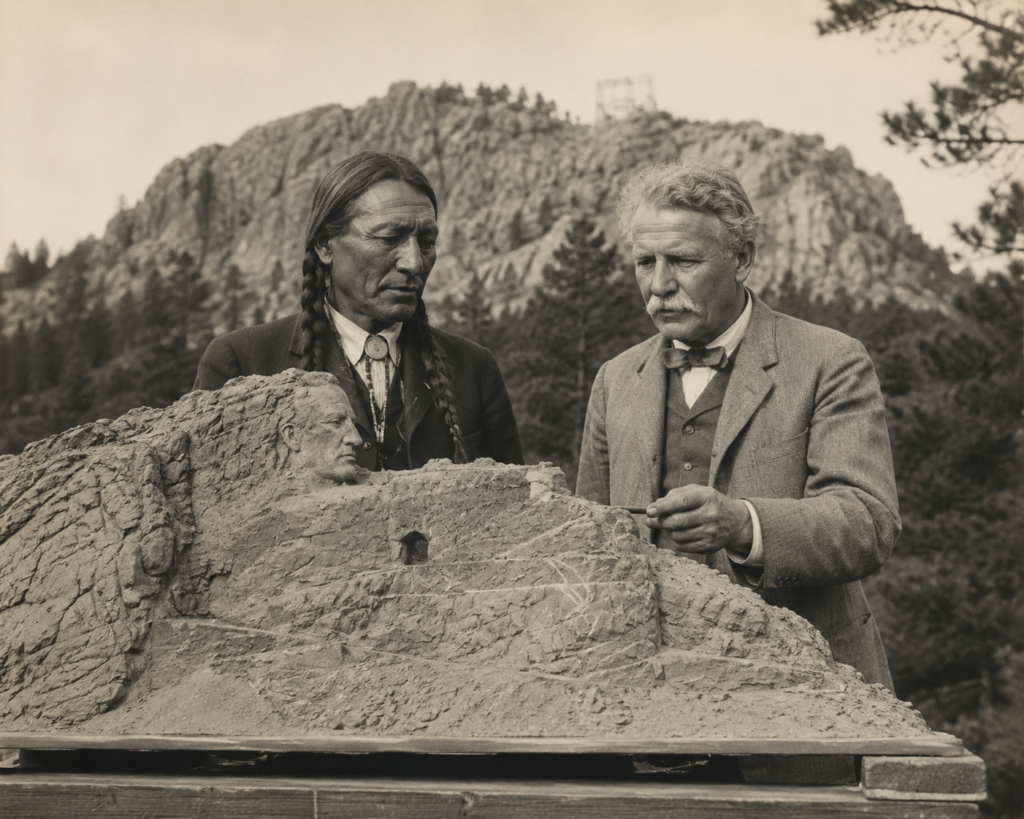
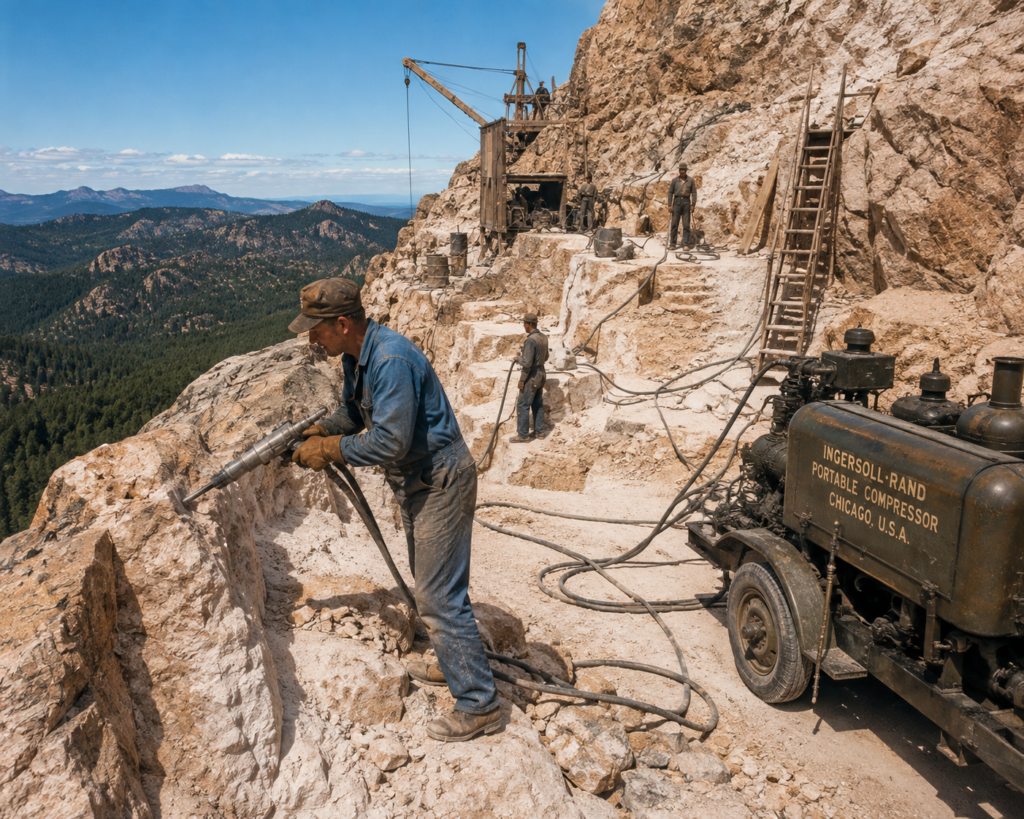
If the finished vision of Crazy Horse Memorial seems almost impossibly ambitious today, imagine what it must have looked like in 1948. Korczak Ziolkowski did not arrive at Thunderhead Mountain with a large construction company, a fleet of heavy equipment or millions of dollars behind him. He began with limited equipment, his own labor and a mountain that would eventually have to be reshaped by removing millions of tons of granite.
The first blast on June 3, 1948, offers some idea of just how modest the beginning really was. Ziolkowski drilled four holes by hand for the explosives, and the resulting blast removed about ten tons of rock. It sounds impressive — until you consider that the sculpture he envisioned would eventually measure 563 feet high and 641 feet long.
In those early years, simply getting himself and his equipment to the work site could be an undertaking. A 741-step wooden staircase provided access to the top of the mountain, while a small jackhammer was powered by an aging gasoline compressor sitting far below. Later, an aerial cable system powered by an antique Chevrolet engine carried equipment and tools up the mountain in a wooden basket appropriately nicknamed “the bucket.”
Before much of the figure could be seen in the granite, visitors were given a remarkable preview of what Ziolkowski intended to create. In 1951, he painted the enormous outline of Crazy Horse directly onto the mountain. The lines were six feet wide and required 176 gallons of paint, transforming the rock face into something resembling a colossal sketch awaiting the sculptor’s tools.
As the decades passed, the tools became more sophisticated and the work more precise. Bulldozers and scaffolding joined the early jackhammer and compressor, tunnels were cut through the mountain, and increasingly sophisticated surveying methods allowed the carving crew to translate the proportions of Ziolkowski’s scale models onto the granite. Today, laser scanning, three-dimensional computer models and precision surveying equipment help determine exactly where rock must be removed. Yet the basic principle remains much the same: measure the model, enlarge those measurements to an extraordinary scale, and carefully uncover the sculpture hidden within the mountain.
Removing the rock is itself a progression from enormous to extraordinarily precise. Modern crews use rock drills and cable saws to remove large blocks during the early stages, then gradually move into rough shaping and finer work as they approach the finished surface. At the detail stage, the scale becomes almost difficult to comprehend: a carving hundreds of feet across can ultimately require a worker with a hammer and chisel refining a small section of granite.
That combination of blasting, engineering, surveying and traditional sculpting helps explain why progress on Crazy Horse can sometimes appear slow from a distance. Before a recognizable feature emerges, tremendous amounts of rock may have been removed from areas that hardly change the familiar silhouette at all. The mountain is not simply being decorated from the outside. It is being carefully dismantled, measured and reshaped to reveal a three-dimensional figure on a scale few sculptors have ever attempted.
And perhaps the most remarkable part is that the techniques used to carve Crazy Horse have evolved almost as dramatically as the mountain itself. What began with four hand-drilled holes, a small jackhammer and improvised equipment has become a sophisticated engineering operation — yet the carving is still guided by the model created more than three-quarters of a century ago.
The tools have changed. The mountain has changed. And the people doing the work have changed as well.
That brings us to the remarkable group of people whose lives became intertwined with Crazy Horse — beginning with Crazy Horse himself.
👥 The People Behind the Mountain
A monument this enormous inevitably draws attention to the mountain, the machinery and the decades of work. But Crazy Horse Memorial is also the story of several very different people whose lives became connected across generations — a Lakota warrior who never saw the memorial, a Lakota leader determined that Native American heroes should be remembered, and a sculptor and family who made that vision their life’s work.
Who Was Crazy Horse?
For anyone unfamiliar with Crazy Horse before encountering the memorial, the first surprise may be how difficult it is to separate the man from the legend.
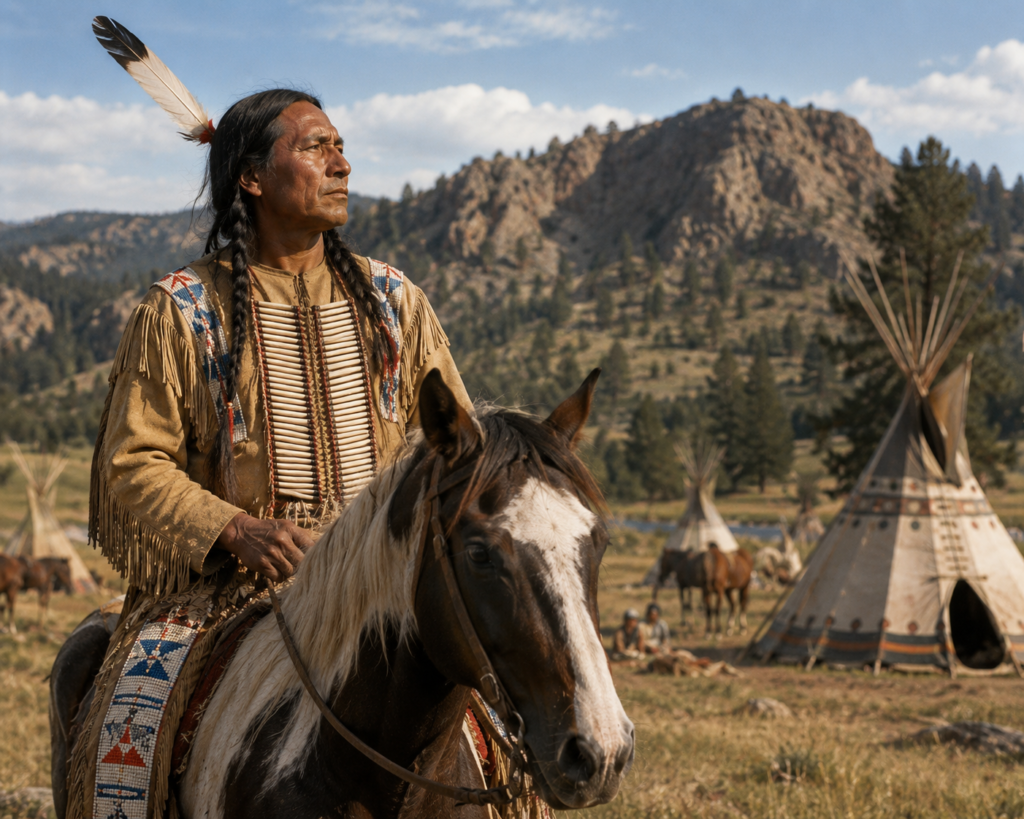
Crazy Horse was born around 1840, probably in or near the Black Hills, although even the date and exact location of his birth are uncertain. He was a member of the Oglala Lakota and as a boy was known as Curley Hair. According to the National Park Service, he was later called Horse On Sight before receiving the name by which history remembers him. His father was also known as Crazy Horse, and after the younger man demonstrated bravery in battle, his father passed the name to his son and thereafter became known as Worm.
The young Crazy Horse grew into a respected warrior and military leader during a period when the Lakota were fighting to protect their lands and traditional way of life from increasing U.S. expansion. He participated in Red Cloud’s War during the 1860s and later played important roles in the Battle of the Rosebud and the Battle of the Little Bighorn in 1876. But defining him only through famous battles misses much of the reason his name endured. Crazy Horse became a symbol of resistance and independence. He did not sign treaties with the United States and resisted reservation life while continuing to defend the land and way of life of his people.
By 1877, however, conditions had become desperate. With the buffalo disappearing and his people struggling to survive, Crazy Horse surrendered at Fort Robinson in Nebraska that May. Only a few months later, on September 5, he was killed there while soldiers attempted to confine him. He was probably only in his thirties.
There is another unusual complication to memorializing him: no authenticated photograph of Crazy Horse is known to exist. The enormous face emerging from the mountain therefore cannot be considered a literal portrait in the way that the faces on Mount Rushmore can. It is an artistic representation intended to embody the man and what he came to represent.
Why Crazy Horse?
Of all the Native American leaders who might have been chosen for such a memorial, why him?
For Henry Standing Bear, the answer was personal as well as symbolic. Standing Bear identified Crazy Horse as his maternal cousin and believed that, as a relative, it was appropriate for him to initiate a memorial in his honor. He also believed the Black Hills — sacred Paha Sapa to the Lakota — were the proper place for it.
Crazy Horse also represented qualities Standing Bear wanted remembered. His courage was certainly part of that legacy, but so were his independence, his modest way of life and his determination to resist the loss of Lakota lands and traditions. A South Dakota historical marker at the memorial describes those qualities as reasons he stood apart even among other celebrated Native American leaders.
Standing Bear’s vision was never simply about making one man larger than life. He wanted a monument capable of making a much broader statement: Native Americans had heroes whose stories also deserved a permanent place in the American landscape. That conviction eventually led him to Korczak Ziolkowski and to the mountain we see being transformed today.
Henry Standing Bear — The Vision Behind the Memorial
Standing Bear’s own story makes his determination particularly interesting. Born in the 1870s, he attended the Carlisle Indian Industrial School in Pennsylvania, an institution created to assimilate Native American children into white American culture. Yet his experience there helped shape a very different mission. He came to believe that education, communication and engagement with the non-Native world could become tools for preserving and explaining Native American culture rather than simply allowing it to disappear.
By the 1930s, as four presidents were taking shape on nearby Mount Rushmore, Standing Bear was pursuing the idea of a monumental Native American figure in the Black Hills. He even advocated for a Native American addition to Mount Rushmore before turning his attention toward creating an entirely separate memorial. His search eventually brought him to Ziolkowski, whom he invited to undertake a project enormous enough to stand as a visible reminder that the history of the Black Hills did not begin with the four presidents carved nearby.
Standing Bear died in 1953, only five years after the first blast. He never saw Crazy Horse’s face emerge from the granite. But without his persistence, there would have been no mountain carving for later generations to continue.
Korczak, Ruth and a Family Project
Korczak Ziolkowski brought a very different life story to the mountain. Orphaned as an infant and raised in foster homes, he became a largely self-taught sculptor and eventually won national recognition for his work. He had even worked briefly at Mount Rushmore in 1939 before Standing Bear’s invitation redirected the course of his life. After serving in World War II and landing at Omaha Beach on D-Day, Ziolkowski returned to the United States and chose the Crazy Horse project over opportunities to create war memorials in Europe.
What began as one man’s undertaking gradually became a family commitment. Ruth Ross arrived as a volunteer, married Korczak in 1950 and became deeply involved in the project. Together they raised ten children at Crazy Horse, where family life and the work on the mountain became almost impossible to separate.
When Korczak died in 1982, that could easily have marked the end of the dream. Instead, Ruth assumed leadership and made a pivotal decision: concentrate work on Crazy Horse’s face so that visitors could begin to see recognizable progress on the mountain. The face was dedicated in 1998, sixteen years after Korczak’s death, and members of the next generation continued participating in both the carving and the operation of the memorial.
That continuity may be one of the most remarkable parts of the Crazy Horse story. Henry Standing Bear did not live to see the face. Korczak did not live to see it. Ruth did not live to see the completed mountain. Yet each generation handed the unfinished work to another.
The result is something quite different from a monument created during a single construction campaign. Crazy Horse Memorial has become a story passed from one generation to the next — not only in the granite being removed from the mountain, but in the people who have chosen to continue the work.
⏳ Will Crazy Horse Memorial Ever Be Finished?
It is probably the most obvious question anyone can ask about Crazy Horse Memorial: After more than 75 years of carving, will it ever actually be finished?
There is still no announced completion date. What exists instead is a project advancing in stages, with each new section requiring enormous amounts of rock to be removed before the finer work can begin. The scale alone helps explain the challenge. Crazy Horse’s completed face is 87½ feet high, while his outstretched arm extends 263 feet across the mountain. His pointing finger alone measures nearly 30 feet. (Crazy Horse Memorial)
The work is also very much continuing. The left hand has taken shape, with detailed finish work still underway, while crews are making saw cuts around the upper arm. Future phases call for work on the left forearm, right shoulder, hairline and portions of the horse’s mane and head. Modern technology may change the pace considerably. The Memorial has raised funds for an industrial tower crane and robotic equipment intended to move larger machinery around the carving more safely and efficiently. According to the Foundation, the new technology could significantly increase productivity and shorten the construction timeline. (Crazy Horse Memorial) (Crazy Horse Memorial Foundation)
But the pace of construction has never been simply a matter of how quickly granite can be removed. From its beginning, Crazy Horse Memorial has followed an unusual financial model. The nonprofit foundation does not accept federal or state funding for the project, relying instead on admissions and private contributions to support both the mountain carving and its broader educational and cultural mission. (Crazy Horse Memorial)
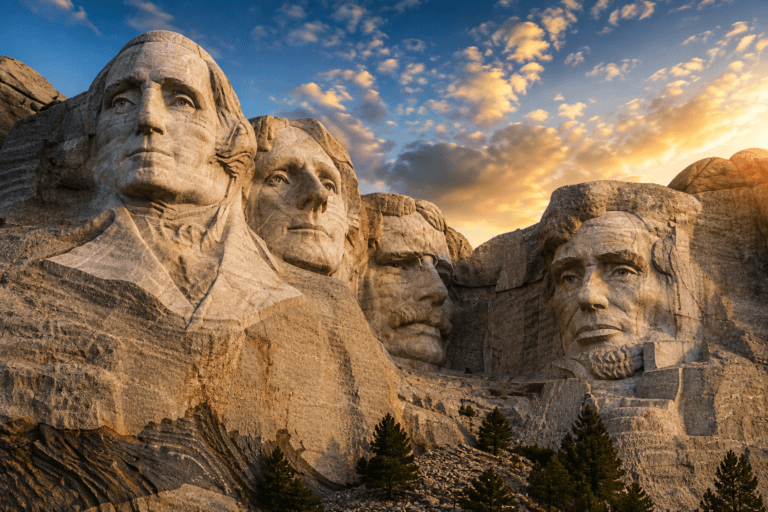
That decision is an important part of the memorial’s identity, and it also helps explain why Crazy Horse has developed so differently from its famous neighbor just 17 miles away. Mount Rushmore’s major carving took place between 1927 and 1941, backed largely by federal funding. Crazy Horse began seven years later and has continued across generations under an entirely different model. One became a completed national memorial; the other remains a monument visitors can literally watch being created.
Perhaps that is why asking when Crazy Horse will be finished doesn’t quite capture what makes the place unusual. Visitors today are not simply looking at an incomplete version of something that will someday become worth seeing. They are seeing one moment in the life of a memorial that has been changing for generations. Someone who stood beneath the mountain in 1980 saw something very different from a visitor arriving after Crazy Horse’s face was completed in 1998. Today’s visitors can see the emerging hand and arm, while future visitors may find the horse itself becoming increasingly recognizable in the granite.
In that sense, Crazy Horse Memorial is both a destination and a work in progress. Perhaps someday a generation will stand beneath Thunderhead Mountain and see Ziolkowski’s entire model finally carved into the mountain. For now, the unfinished sculpture is not merely something visitors have to overlook. It is part of the experience — and part of the story.
Yet the length of construction is only one reason Crazy Horse Memorial inspires so much discussion. The project itself has always carried deeper questions about remembrance, representation, the sacred Black Hills and who has the right to decide how a historical figure should be memorialized.
🪶 More Than a Mountain Carving
It would be easy to assume that everything at Crazy Horse Memorial exists for one purpose: finishing the enormous figure slowly emerging from Thunderhead Mountain. But the carving was never intended to be the entire dream. Over the decades, education, cultural preservation and the sharing of Native American history have become central to the mission — even as the memorial itself has continued to inspire very different opinions about what it means to honor Crazy Horse.
The Larger Vision
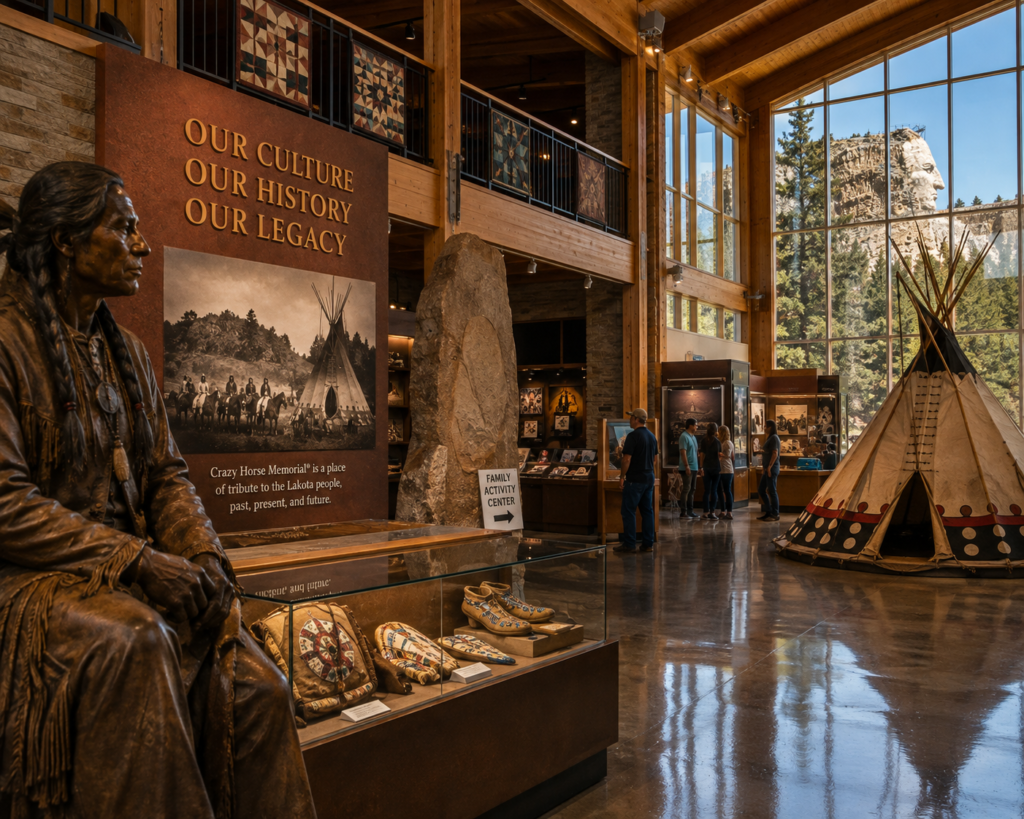
Henry Standing Bear wanted the world to recognize that Native Americans had heroes worthy of remembrance, but the vision that developed with Korczak and Ruth Ziolkowski eventually reached beyond commemorating a single man. Today, the Crazy Horse Memorial Foundation describes its mission as protecting and preserving the cultures, traditions and living heritage of the Indigenous peoples of North America through the mountain carving, museums, cultural programming and higher education. (Crazy Horse Memorial)
That broader mission is perhaps most visible in The Indian Museum of North America, which grew from a single collection donated in 1965. Its collections now represent the histories and cultures of more than 300 Native Nations, making an important point that could easily be lost at a memorial dominated by one colossal Lakota figure: there is no single Native American story. The Native American Educational and Cultural Center carries that idea further by providing opportunities for Native artists, performers and storytellers to share living cultures directly with visitors. (Crazy Horse Memorial) (Crazy Horse Memorial)
Education has also become an important part of the larger vision. A scholarship program begun in 1978 eventually grew into millions of dollars in assistance for Native American students, while what is now Crazy Horse Memorial University has expanded the educational mission through college coursework and partnerships with other institutions. (Crazy Horse Memorial)
Seen from that perspective, the unfinished mountain begins to look somewhat different. The carving may be what first catches the eye, but Crazy Horse Memorial is not waiting for the mountain to be finished before attempting to fulfill its larger purpose. Museums are preserving Native American history, artists and performers are sharing their cultures, and students are pursuing educational opportunities while the drilling and blasting continue above them.
Yet understanding that larger mission does not settle every question surrounding the memorial.
A Memorial with More Than One Story
There is no single Native American perspective on Crazy Horse Memorial, nor even one universally shared Lakota view. Some see the enormous Native American figure rising within sight of Mount Rushmore as a powerful statement that the history of the Black Hills extends far beyond the four presidents carved nearby. Native artists, performers and students continue to participate in the memorial’s programs, and supporters point to its educational and cultural work as evidence that Standing Bear’s original dream has grown into something meaningful.
Others, including Lakota leaders and members of Crazy Horse’s extended family, have raised much deeper questions — beginning with whether the mountain should have been carved at all. (The New Yorker)
Should a Sacred Mountain Be Carved?
The Black Hills — Paha Sapa — hold profound spiritual and cultural significance for the Lakota and other Indigenous peoples. For some critics, carving any enormous human figure into these mountains is difficult to reconcile with their sacred character.
That creates a striking paradox. Crazy Horse spent much of his life resisting the loss of Lakota lands and defending a way of life deeply connected to this landscape. Can dramatically altering that same landscape truly honor him?
For supporters, the monumental scale makes a Native American figure impossible to overlook in a region where Mount Rushmore has long dominated the popular story. For critics, carving another mountain does not correct what they regard as the underlying problem.
Would Crazy Horse Have Wanted a Monument?
There is no way to know what Crazy Horse himself would have thought, but what is known about him makes the question particularly compelling.
No authenticated photograph of Crazy Horse is known to exist, and accounts describe a private man who resisted having his image recorded. Even the location of his burial remains uncertain.. The face emerging from Thunderhead Mountain therefore cannot be a conventional portrait; it is an artistic representation intended to symbolize Crazy Horse and what he came to represent. (Smithsonian Magazine)
Yet the absence of an authenticated image raises an unavoidable question: If Crazy Horse chose not to leave an image of himself behind, would he have wanted later generations to create one hundreds of feet high?
Supporters view the sculpture as a tribute to his courage, independence and defense of his people. Critics see the contradiction itself as a reason to question whether this is the kind of memorial he would have wanted.
Who Had the Right to Decide?
Henry Standing Bear’s role makes that question even more complicated. As we have already seen, Standing Bear identified Crazy Horse as a relative and spent years pursuing his dream of a Native American monument in the Black Hills. His invitation to Korczak Ziolkowski ultimately set the entire project in motion.
Some members of Crazy Horse’s extended family, however, have challenged whether Standing Bear had the authority to make that decision without broader family agreement. Elaine Quiver, a descendant of one of Crazy Horse’s aunts, has argued that such a decision required family consensus under Lakota tradition and that Crazy Horse’s descendants were not consulted before the carving began. (VOA)
That does not erase Standing Bear’s vision or the sincerity behind it. It does remind us, however, that saying “the Lakota wanted the memorial” oversimplifies a much more complicated story. One Lakota leader initiated the project; that does not mean he necessarily spoke for every Lakota person then or now.
A Memorial, a Mission — and a Business
The extraordinary length of the project has created still another source of debate. Crazy Horse Memorial attracts paying visitors, accepts donations and operates museums, shops and other visitor facilities as part of a substantial nonprofit organization. Some critics have questioned the commercialization surrounding Crazy Horse’s name and whether the institution benefits Native people sufficiently.
The Foundation points to its museums, scholarships, educational programs, cultural programming and university initiative as evidence of a broader mission. Those efforts make the picture considerably more complicated than simply labeling Crazy Horse Memorial either a tribute or a tourist attraction.
Perhaps the most useful way to understand the memorial is to allow those different truths to exist together. The project can have originated in Henry Standing Bear’s genuine desire to honor Native American heroes and still raise legitimate questions about who has the right to represent Crazy Horse. Its educational programs can provide meaningful opportunities while critics continue to question the institution surrounding them. The carving can inspire some people while deeply troubling others.
Even the comparison with Mount Rushmore becomes more complicated from that perspective. Crazy Horse Memorial was conceived partly as an answer to a landscape where four enormous American presidents looked out from the Black Hills. Yet for those who believe the sacred mountains should never have been carved, adding another monumental figure does not necessarily resolve the underlying issue.
Perhaps that is why Crazy Horse Memorial is ultimately more interesting than its enormous dimensions alone would suggest. The mountain does not tell visitors what to think. It gives them something to think about.
The questions surrounding Crazy Horse — who he was, what he represented, who has the right to tell his story and what it means to honor someone after he is gone — remain unfinished in much the same way as the sculpture itself.
🌄 Crazy Horse Memorial — Today and Tomorrow
More than three-quarters of a century after the first blast, Crazy Horse Memorial remains a place caught between what has already been accomplished and what may still lie generations ahead. Crazy Horse’s face has looked out from Thunderhead Mountain since its completion in 1998, while work continues on other portions of the enormous figure. Modern equipment and technology have changed the way the mountain is carved, but the sculpture still follows the vision Korczak Ziolkowski left behind. (Crazy Horse Memorial)
At the same time, the destination below the mountain continues to evolve. Museums, cultural programs and educational initiatives have made Crazy Horse something very different from the solitary carving project that began in 1948. Whether the mountain itself is completed decades from now or much farther into the future, the memorial has already become part of the continuing conversation about Native American history, cultural representation and the complicated history of the Black Hills.
Perhaps that is also what makes seeing Crazy Horse today so unusual. Most historic landmarks ask us to look backward at something already completed. Crazy Horse asks us to look backward and forward at the same time. Visitors can learn about a Lakota leader who lived in the nineteenth century, the people who dreamed of memorializing him in the twentieth, and the crews still changing the mountain in the twenty-first.
A future visitor may see a dramatically different Crazy Horse rising from the granite. Another generation may someday see the horse’s head, flowing mane and enormous figure much closer to Ziolkowski’s original model. No one can say with certainty when — or even exactly how — that final chapter will be written.
For now, the unfinished mountain remains part of the experience.
It is a memorial to a man who left no authenticated photograph behind, begun by people who knew they would never live to see it completed, and continued by generations who inherited both the dream and the questions surrounding it.
Perhaps that is the most fitting way to leave Crazy Horse Memorial: not with every question answered, but looking once more toward the mountain and realizing that its story is still being written in stone.