Interesting Facts About Mount Rushmore You Probably Never Knew
Hidden Facts, Forgotten Dreams, and the Legends Behind America’s Most Famous Monument
Millions of people visit Mount Rushmore each year, but most leave without discovering some of its most fascinating stories. Behind the familiar granite faces are unfinished dreams, remarkable engineering feats, little-known facts, and enduring legends that reveal a very different side of America’s most famous monument.
Some of these stories are well documented. Others have become part of Mount Rushmore’s enduring folklore. Together, they remind us that history isn’t just carved in stone—it’s also found in the stories we continue to tell.
🗿 The Story Behind the Landmark
Imagine standing before Mount Rushmore on the day the carving was declared complete. Crowds celebrated an extraordinary achievement, newspapers praised the monument, and America had gained a new national icon. Yet one man would have looked at those towering granite faces and seen something entirely different. To sculptor Gutzon Borglum, Mount Rushmore wasn’t finished at all.
The four presidential faces were only the beginning of a dream that stretched far beyond the granite visitors see today. Borglum envisioned towering figures carved from the waist up, complete with detailed clothing and expressive hands. Hidden deep inside the mountain, he planned an impressive Hall of Records where future generations could discover the story of America’s founding and the ideals that shaped the nation.
But history had other plans. Time, limited funding, unforgiving granite, and the growing shadow of World War II slowly forced those grand ideas aside. When Borglum died in 1941, the dream died with him. His son, Lincoln Borglum, completed the work that remained, but the larger vision would never become reality.
That means every visitor who stands before Mount Rushmore today is seeing both a masterpiece and an unfinished dream. Behind the famous faces lies the story of a monument that was always meant to be even greater than the one we know today. Once you know that story, it’s impossible to look at Mount Rushmore in quite the same way again.
🔍 Hidden Details Most Visitors Miss
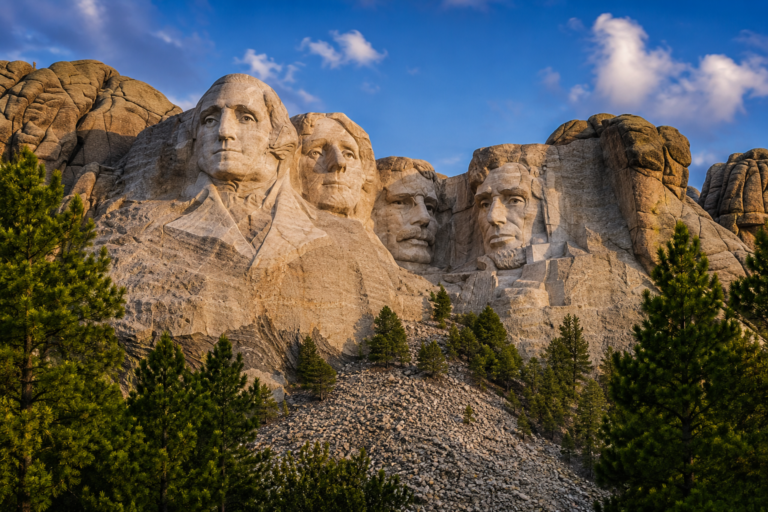
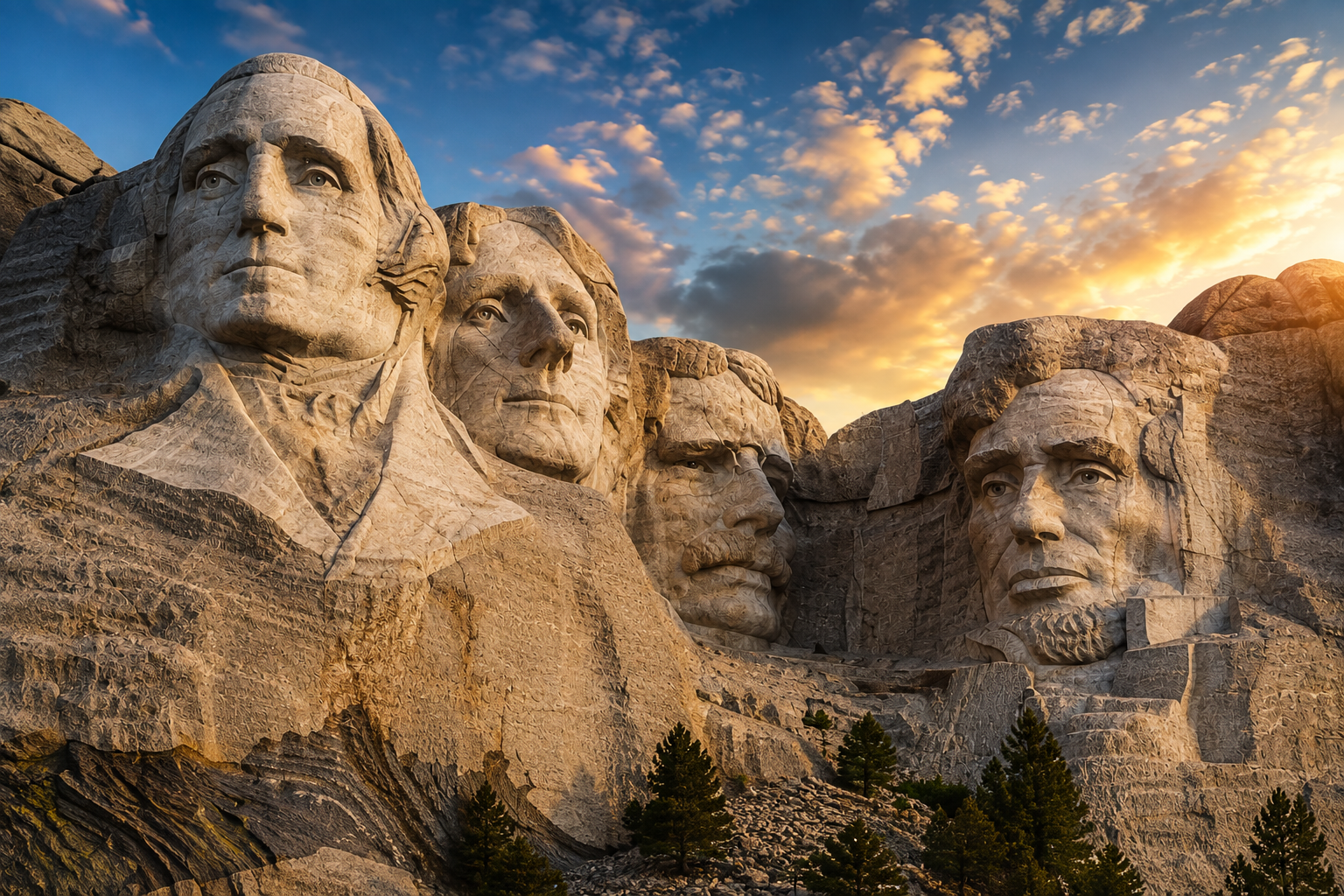
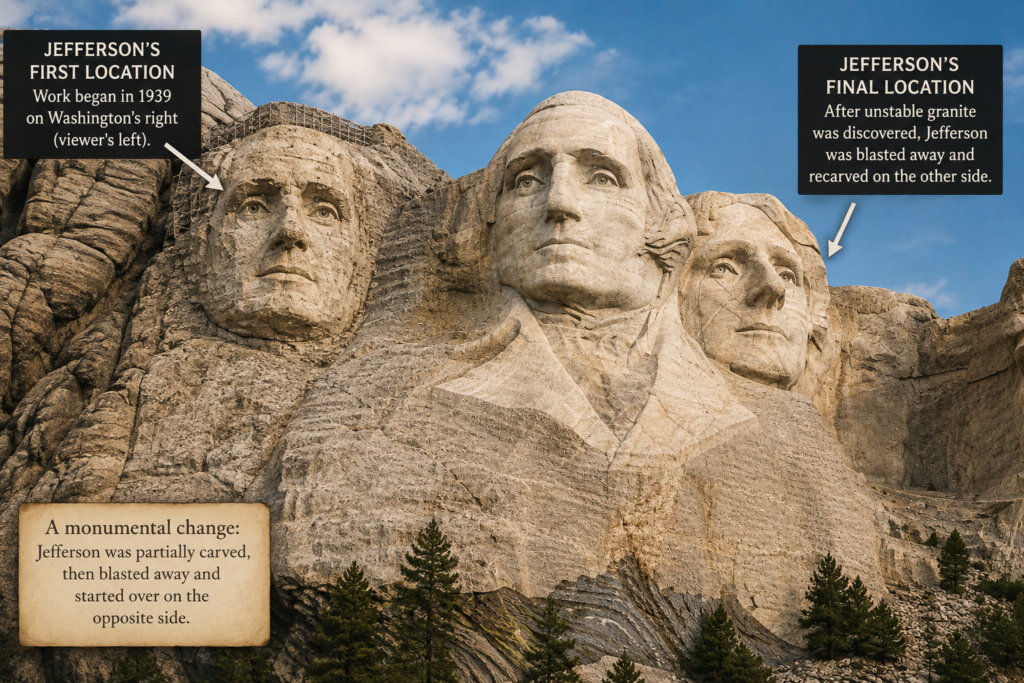
Most visitors spend their time looking at the four famous faces. Few realize that some of Mount Rushmore’s most fascinating details are hiding in plain sight. Take a closer look at Thomas Jefferson. He wasn’t always where you see him today. Borglum originally began carving Jefferson on George Washington’s right side, but the granite proved too unstable. After months of work, the partially completed carving was blasted away, and Jefferson was started again on Washington’s left. It’s hard to imagine the monument any other way, yet Mount Rushmore almost had a completely different appearance.
Then there’s the size of the faces themselves. Standing at the viewing terrace, it’s difficult to appreciate their true scale. Each presidential head stands about 60 feet tall, with noses measuring approximately 20 feet in length and eyes about 11 feet across. Those larger-than-life proportions weren’t simply for dramatic effect—they ensured the monument could be recognized from a great distance.
Another detail many visitors overlook is that dynamite—not chisels—did most of the carving. Nearly 90 percent of the mountain was shaped with carefully placed blasts. Skilled workers then used drills and hand tools to refine the features, transforming rough granite into the familiar expressions we recognize today. Finally, look closely at the faces themselves. They aren’t perfectly symmetrical, and they were never intended to be. Borglum believed that slight imperfections made the sculptures appear more lifelike, especially when changing sunlight cast different shadows across the granite throughout the day.
The next time you see a photograph of Mount Rushmore—or stand before it in person—you may notice details that have been there all along, quietly waiting for someone to look a little closer.
😲 Things That Surprise Most Visitors
Ask someone how they think Mount Rushmore was carved, and chances are they’ll picture sculptors patiently chipping away with chisels and hammers. The truth is far more dramatic.
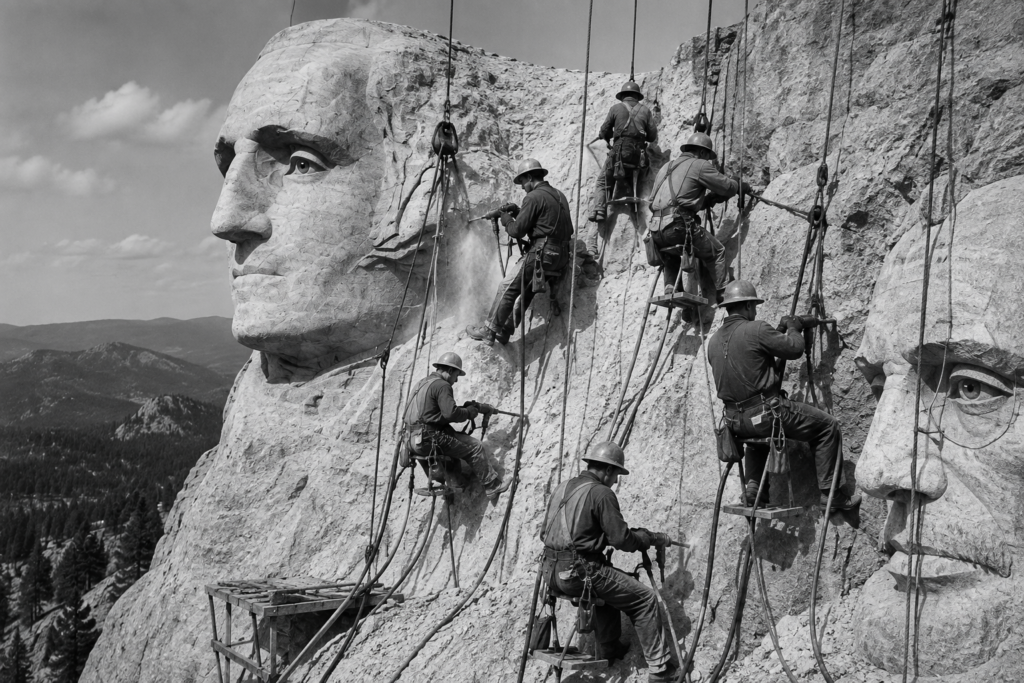
Nearly 90 percent of the mountain was carved with dynamite. More than 400,000 tons of granite were carefully blasted away before skilled workers used drills, hammers, and hand tools to shape the presidents’ familiar features. Every explosion had to be precisely calculated. Remove too much rock, and there was no way to put it back. Another surprise is just how dangerous the work appeared. Workers dangled from steel cables hundreds of feet above the ground, balancing on small seats known as bosun’s chairs while operating heavy pneumatic drills. Looking at old photographs, it’s easy to assume the project claimed many lives.
Remarkably, not a single worker was killed during the carving of Mount Rushmore. Although accidents and injuries did occur, the monument remains one of the few major construction projects of its era completed without a fatality. Perhaps the biggest surprise of all is that the monument was finished in just 14 years. Considering its enormous scale, many visitors assume the project took decades. Yet between 1927 and 1941, a relatively small crew transformed an ordinary mountainside into one of America’s most recognizable landmarks.
The next time you look at Mount Rushmore, it may be impossible to see only four familiar faces. Instead, you’ll see thousands of carefully planned explosions, extraordinary craftsmanship, and the determination of workers who accomplished what many believed couldn’t be done.
🤔 Did You Know?
Why Did Mount Rushmore Almost Look Completely Different?
Most people assume that Mount Rushmore was always intended to honor four American presidents. In reality, the monument nearly became something entirely different. The original idea didn’t even come from sculptor Gutzon Borglum. It came from South Dakota state historian Doane Robinson, who wanted to attract visitors to the Black Hills by carving famous figures from the American West into the granite. His list included legendary names such as Lewis and Clark, Buffalo Bill Cody, Red Cloud, and other explorers and frontier heroes who helped shape the region’s history.
When Borglum was invited to lead the project, however, he had a much grander vision. He believed the monument should represent the story of the entire nation, not just the American West. Instead of celebrating regional heroes, he chose four presidents whose lives symbolized the birth, growth, development, and preservation of the United States.
That single decision changed the monument forever. Imagine standing before the mountain today and seeing Buffalo Bill where Abraham Lincoln now stands—or Lewis and Clark instead of Theodore Roosevelt. It would still be an impressive sculpture, but it would tell an entirely different story about America.
Looking at Mount Rushmore today, it’s easy to believe the monument was inevitable. Yet one conversation, one sculptor’s vision, and one bold decision transformed what could have been a tribute to the Old West into one of the most recognizable symbols of the United States. Sometimes the most fascinating part of history isn’t what happened—it’s realizing how close history came to taking a completely different path.
Why Was Thomas Jefferson Carved Twice?
Thomas Jefferson appears only once on Mount Rushmore today, but workers actually began carving his face in an entirely different location. In 1931, Jefferson was positioned on the opposite side of George Washington from where visitors see him now. Work continued there for approximately eighteen months, and a substantial portion of his face began to emerge from the mountain. Then the sculptors encountered a serious problem.
The granite contained cracks and weaker sections of rock that made the location unsuitable for such a massive sculpture. No amount of careful carving could change the quality of the stone, and continuing there could have threatened the stability of Jefferson’s face. Gutzon Borglum was forced to make a painful decision: the partially carved face had to be destroyed. Workers used dynamite to blast away their earlier work, erasing months of painstaking effort from the mountain. Jefferson was then moved to the other side of Washington, where the granite was strong enough to support the design. That second location is where his face remains today.
The change affected more than Jefferson. Rearranging the presidents forced Borglum to reconsider the placement of other planned features, including the enormous inscription known as the Entablature. The space originally intended for that inscription eventually became part of Abraham Lincoln’s location instead.
It is difficult to imagine deliberately destroying a sculpture after spending so many months creating it. Yet the decision reveals something important about Mount Rushmore: the monument was not carved according to a perfectly predictable plan. Borglum and his workers continually adapted to the mountain itself.
The Jefferson visitors see today is therefore more than a portrait carved in granite. He is also evidence of an earlier face that had to disappear before the familiar Mount Rushmore could take shape.
What’s Hidden Behind Abraham Lincoln’s Head?
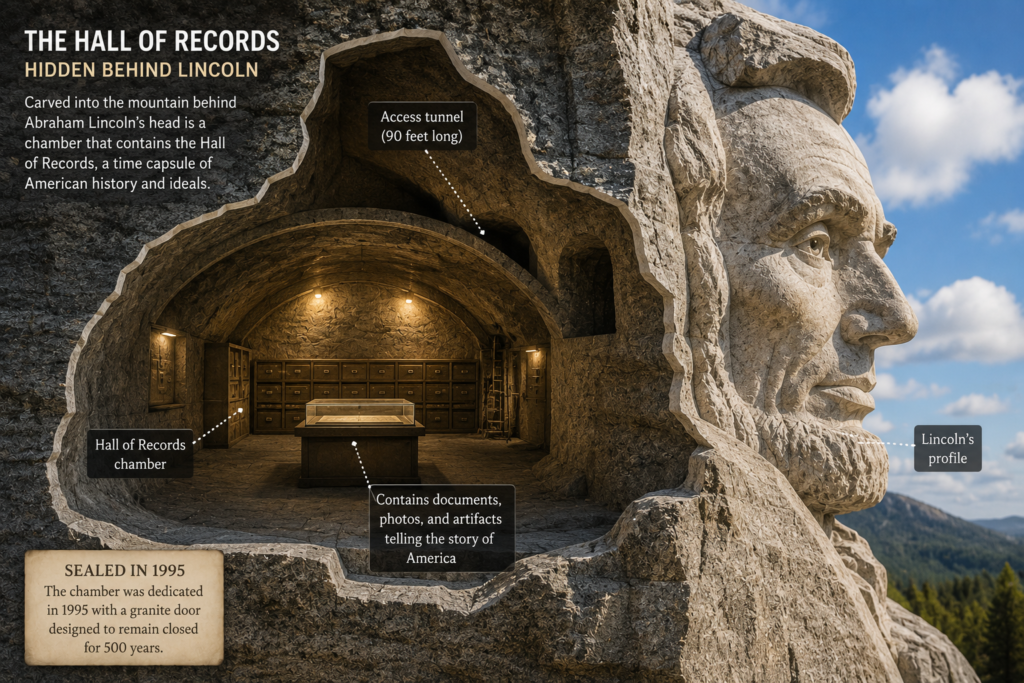
Millions of visitors have stood before Mount Rushmore, admired the four presidential faces, taken photographs, and driven away without realizing that an unfinished chamber is hidden inside the mountain behind Abraham Lincoln’s head. Known as the Hall of Records, the chamber was one of Gutzon Borglum’s most ambitious ideas. He envisioned a grand room where future generations could learn the story of the United States and understand why these four presidents were chosen. The room would have contained important historical documents, biographies, and records explaining the nation’s founding and growth.
Work on the chamber began in 1938. Workers blasted a tunnel approximately 70 feet into the granite, but the project quickly proved far more difficult and expensive than expected. With funding limited and Congress insisting that the presidential faces be completed first, construction on the Hall of Records came to an end before Borglum’s vision could be realized.
For decades, the unfinished chamber remained largely forgotten. Then, in 1998, the National Park Service fulfilled part of Borglum’s dream. A sealed titanium vault was placed inside the chamber containing sixteen porcelain enamel panels that tell the story of Mount Rushmore, explain the significance of the four presidents, and preserve important information about the monument for future generations.
Although visitors cannot enter the chamber, it is still there—hidden inside the mountain, quietly protecting its message for the future. Knowing that a hidden room exists behind Lincoln’s head changes the way many people see Mount Rushmore. It isn’t just a sculpture carved into granite. It’s also a monument with a secret tucked safely inside the mountain itself—a secret most visitors never realize is there.
How Can You See Theodore Roosevelt’s Glasses When They Aren’t Really There?
Take a close look at Theodore Roosevelt’s face, and you might notice something unexpected. It almost appears as though he is wearing a pair of eyeglasses.
Of course, there are no actual glasses carved into the granite. Instead, Gutzon Borglum used a brilliant artistic illusion. Rather than attempting to carve delicate wire frames—which would have been impossible to preserve in solid granite—he sculpted only the bridge of Roosevelt’s pince-nez glasses where they rested on his nose. Your brain naturally completes the image, making it look as though the entire pair of glasses is still there.
It is a remarkably simple technique, yet it creates one of Mount Rushmore’s most realistic details. The choice was no accident. Borglum wanted each president to be instantly recognizable, even from hundreds of feet away. Washington’s strong profile, Jefferson’s youthful appearance, Lincoln’s thoughtful expression, and Roosevelt’s distinctive glasses all helped give each face its own personality without overwhelming the monument with unnecessary detail.
Today, many visitors don’t notice the illusion until someone points it out. Once they do, it’s almost impossible to unsee. The tiny granite bridge suddenly becomes an entire pair of spectacles in your mind. It’s a reminder that Mount Rushmore is more than an engineering achievement—it is also a masterpiece of artistic design. Sometimes the smallest details are the ones that leave the biggest impression.
How Did Workers Hang Hundreds of Feet Above the Ground?
When visitors admire Mount Rushmore today, it’s easy to focus on the finished monument and forget the people who brought it to life. Yet every curve, every expression, and every carefully carved feature began with men willing to spend their days suspended high above the Black Hills. Each morning, workers climbed to the top of the mountain, settled into small canvas-and-wood seats known as bosun’s chairs, and were slowly lowered down the granite face by steel cables. From those swaying seats, often hundreds of feet above the ground, they operated heavy pneumatic drills, placed carefully measured charges of dynamite, and chipped away at one of the hardest types of rock in America.
The photographs from the construction years are almost unbelievable. There were no enclosed platforms, no modern safety harnesses, and no guardrails separating the workers from the granite cliffs below. Looking at those images today, many people assume the project must have claimed numerous lives. Surprisingly, it didn’t.
Although accidents and injuries did occur during the fourteen years of construction, not a single worker was killed while carving Mount Rushmore. It’s an astonishing safety record, especially considering the conditions under which they worked and the technology available during the 1930s.
What makes the story even more remarkable is that these men weren’t famous sculptors. Most were miners, quarry workers, ranch hands, and local laborers who came to the project because it offered a steady paycheck during the Great Depression. Under Borglum’s direction, they learned the specialized skills needed to transform a rugged mountainside into one of America’s most recognizable landmarks.
Standing at the viewing terrace today, it’s easy to admire the four familiar faces towering above the pines. But perhaps the greatest monument isn’t carved in the granite at all. It’s the determination, courage, and craftsmanship of the ordinary men who trusted a steel cable each morning and helped turn an impossible dream into reality.
Could Mount Rushmore Ever Be Finished?
For most visitors, Mount Rushmore looks complete. The four presidential faces appear exactly as they were intended, standing proudly above the Black Hills more than eighty years after the last blast of dynamite echoed across the mountain.
Gutzon Borglum, however, likely would have seen something very different. His original vision extended far beyond the familiar faces that millions of people photograph each year. He imagined presidents carved from the waist up, detailed clothing, expressive hands, and a magnificent Hall of Records where future generations could better understand the nation’s history. What visitors see today is only a portion of the monument Borglum hoped to create.
Could that dream ever be completed? The answer is almost certainly no. Modern engineers believe that carving the remaining portions of the figures would present enormous technical challenges. More importantly, the National Park Service considers Mount Rushmore a completed historic monument, not an unfinished project waiting for future sculptors. Any attempt to expand the carving would alter the work that generations have come to recognize and admire.
Perhaps that’s exactly as it should be. History often leaves us with unfinished dreams. Great cathedrals took centuries to build. Castles remain incomplete. Ancient ruins hint at plans that were never fulfilled. Mount Rushmore belongs in that company—not because it failed, but because it reminds us that even the grandest visions are shaped by time, circumstance, and the limits of the people who pursue them.
Knowing what Borglum imagined doesn’t make Mount Rushmore feel incomplete. Instead, it invites us to appreciate not only what was accomplished, but also the extraordinary dream that inspired it. Sometimes the most fascinating part of history isn’t what was finished—it’s imagining what might have been.
🌄 Before You Leave
By now, you’ve probably discovered that Mount Rushmore is far more than four familiar faces carved into granite.
Behind the monument are unfinished dreams, remarkable engineering, hidden chambers, optical illusions, and stories that most visitors never hear. Some are firmly rooted in history. Others have grown into legends passed from one generation to the next. Together, they remind us that every historic landmark has two stories to tell—the one everyone knows and the one waiting to be discovered.
The next time you see a photograph of Mount Rushmore—or better yet, stand before it yourself—you may find your eyes drawn to details you would have overlooked before. You might remember the mountain that almost honored Western heroes instead of presidents, the hidden chamber behind Lincoln’s head, or the workers who trusted little more than steel cables and determination to bring an impossible vision to life. That’s part of the joy of discovering America’s historic places. The more you learn, the more you see.
If you enjoyed uncovering these lesser-known stories, you may also enjoy exploring our Visit & Tour Guide to Mount Rushmore, where you’ll find practical tips for planning your visit, the best viewpoints, and ideas for making the most of your time in the Black Hills. Because sometimes the greatest discoveries aren’t the ones everyone expects to find—they’re the stories you carry home with you.