Mount Rushmore Tour: What The Experience Is Really Like
A Mount Rushmore tour is not a conventional tour with a guide leading visitors through a series of rooms or exhibits. The experience unfolds largely at your own pace—through open plazas and shaded forest, past flags shifting in the wind, and from broad terrace views to quieter places beneath the mountain. The route leads from the entrance and Avenue of Flags to the Grand View Terrace, visitor center, Presidential Trail, Sculptor’s Studio, and other areas overlooking the sculpture.
The first sight of the sculpture is unquestionably the centerpiece, but the memorial becomes more meaningful when you move beyond the primary viewing terrace. On the trail, voices and camera shutters gradually give way to wind moving through ponderosa pines and footsteps on stone. Exhibits reveal how the mountain was carved, interpret the lives and eras represented by the four presidents, and introduce the much older relationship between Indigenous people and the Black Hills.
The experience can be brief or surprisingly layered. Some visitors photograph the mountain, browse the gift shop, and leave within an hour. Others walk the Presidential Trail, attend ranger programs, explore the museum, eat at Carvers’ Café, and remain for the evening lighting ceremony. How much of Mount Rushmore you experience depends largely on how much time you choose to give it.
For the history of the memorial, its creation, and the people behind it, see Mount Rushmore National Memorial: The Story Behind America’s Most Recognizable Landmark.
🧭 Arriving at Mount Rushmore
Mount Rushmore lies along South Dakota Highway 244 in the Black Hills, several miles outside Keystone. The approach winds through forested hills, where the scent of pine may enter through an open window and pale granite appears between the trees. The road begins separating the memorial from the commercial attractions and communities surrounding it, but drivers should not expect a dramatic view of all four presidents from the entrance road. The complete sculpture generally reveals itself only after visitors have parked and entered the memorial.
Vehicles pass through parking booths before continuing into a multilevel parking complex. Although Mount Rushmore National Memorial does not charge an entrance fee, the independently operated parking facility does charge for parking. National park passes do not cover that charge. A parking ticket for a noncommercial vehicle provides unlimited entry for one year from the date of purchase, making it useful for visitors who want to return later in the day or on another day during the same trip.
No shuttle is needed after parking. Elevators, stairs, and walkways lead from the enclosed garages toward the open entrance plaza. That transition—from concrete structure to sky, forest, and granite—is part of the arrival, and the mountain gradually comes into view rather than appearing all at once. The parking structures are close to the main visitor areas, but the size and multiple levels can make it helpful to note where you left your vehicle before beginning the visit.
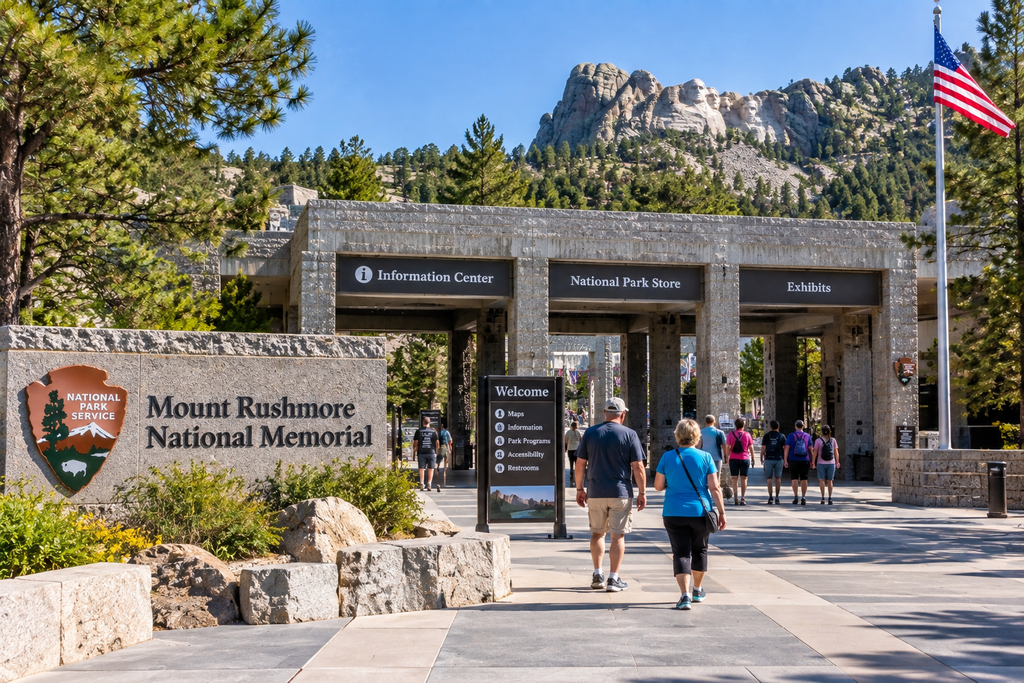
The Information Center near the entrance is a useful first stop for current program schedules, trail conditions, accessibility assistance, and questions about the memorial. It is also where visitors can obtain available brochures and inquire about self-guided tour options.
🚩The Avenue of Flags and First View of the Mountain
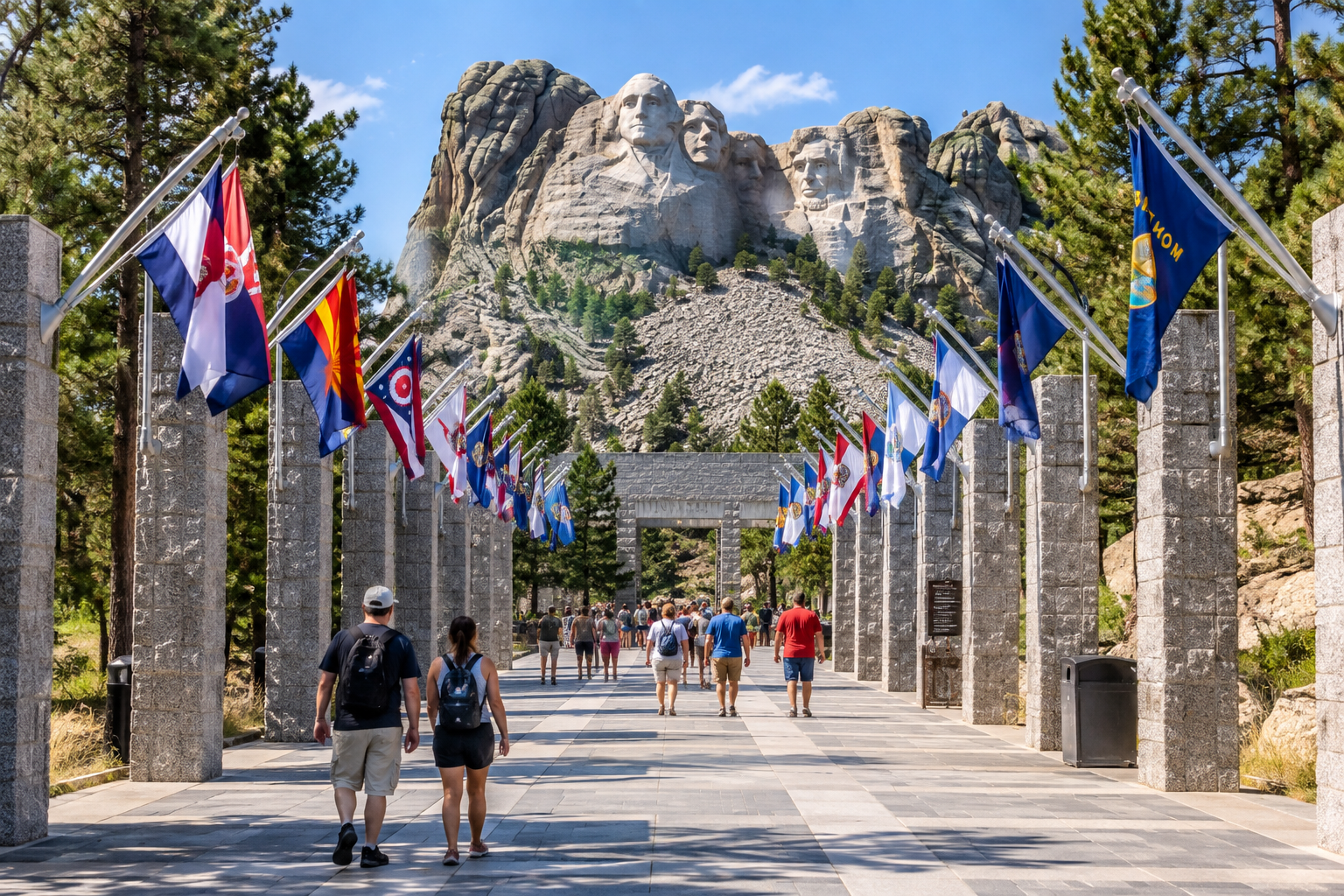
Beyond the entrance, visitors pass through the Avenue of Flags, a broad walkway lined with the flags of the states, territories, commonwealths, and District of Columbia. The columns create a ceremonial approach, framing glimpses of the sculpture as visitors move toward the Grand View Terrace. On a breezy day, fabric snaps overhead and halyard hardware taps against the poles, adding movement and sound to the formal walkway.
This is where the experience begins to feel different from seeing Mount Rushmore in photographs. The presidents’ faces may appear smaller than some visitors expect when viewed against the entire mountain, yet their position high above the surrounding forest gives them a presence that photographs rarely communicate. The first reaction may be surprise, awe, or simply the odd familiarity of finally standing before an image known for a lifetime. Changes in cloud cover and sunlight continually alter the granite, sharpening one face while placing another in shadow.
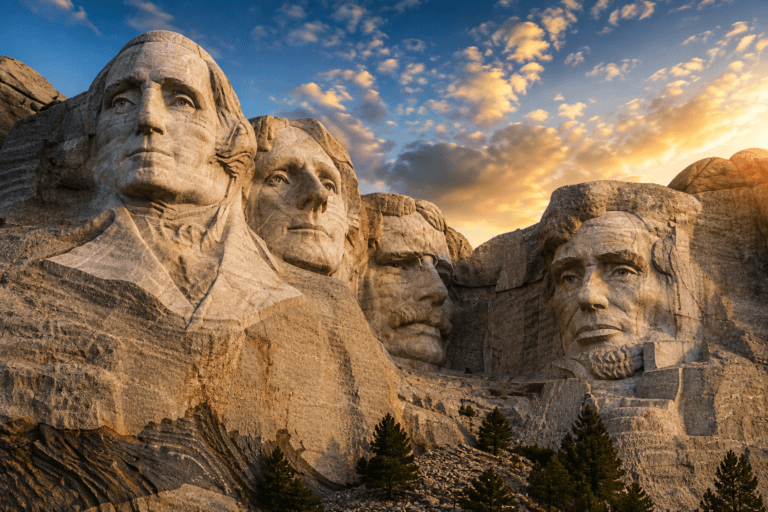
The Grand View Terrace provides the familiar straight-on view of George Washington, Thomas Jefferson, Theodore Roosevelt, and Abraham Lincoln. It is the natural place for photographs, and the soundscape can be lively—families gathering, cameras clicking, and conversations in many voices. Yet it is also worth finding a place to stand still before moving on. Much of the memorial’s power comes from the contrast between the carefully carved faces and the broken granite below them, where remnants of the carving process remain scattered across the mountainside.
Crowds tend to gather along the center of the terrace, particularly during summer. Moving toward either end can offer a little more room and a different angle without leaving the main viewing area.
🎥 Inside the Lincoln Borglum Visitor Center
The Lincoln Borglum Visitor Center is located below the Grand View Terrace and can be reached by stairs or elevators. Because the mountain remains visible above, it is easy to overlook the building and continue directly to the trail. Doing so, however, means missing much of the interpretation that explains what visitors are actually seeing.
Exhibits explore the selection of the presidents, sculptor Gutzon Borglum’s vision, the workers who transformed the mountain, and the methods used during construction. Historical photographs, tools, models, and films help translate the scale of the project into understandable terms. From the terrace, the faces can appear smooth and almost inevitable. Inside the museum, the story becomes louder and more physical in the imagination: dynamite breaking granite, drills biting into stone, cables supporting workers high above the ground, and years of dust and labor behind every finished feature.
The visitor center also provides an important opportunity to consider the memorial as more than a photograph. The four presidents were selected to represent themes of national birth, growth, development, and preservation, but the meaning of Mount Rushmore has continued to evolve. Exhibits and programs can help visitors think about both the ideals the memorial was created to celebrate and the more complicated history of the land on which it stands.
Visitors who want context before walking the Presidential Trail may prefer to see the museum first. Those primarily interested in an unobstructed outdoor experience can walk the trail and return to the visitor center afterward.
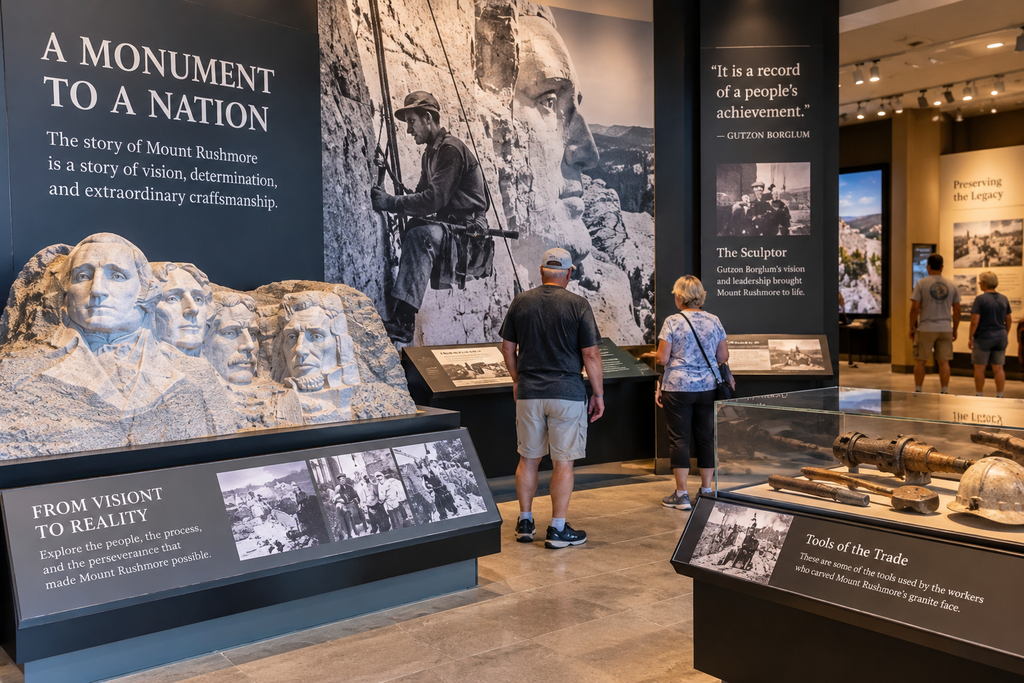
Exhibits inside the Lincoln Borglum Visitor Center reveal the people, tools, and enormous effort behind the carving of Mount Rushmore.🥾 Walking the Presidential Trail
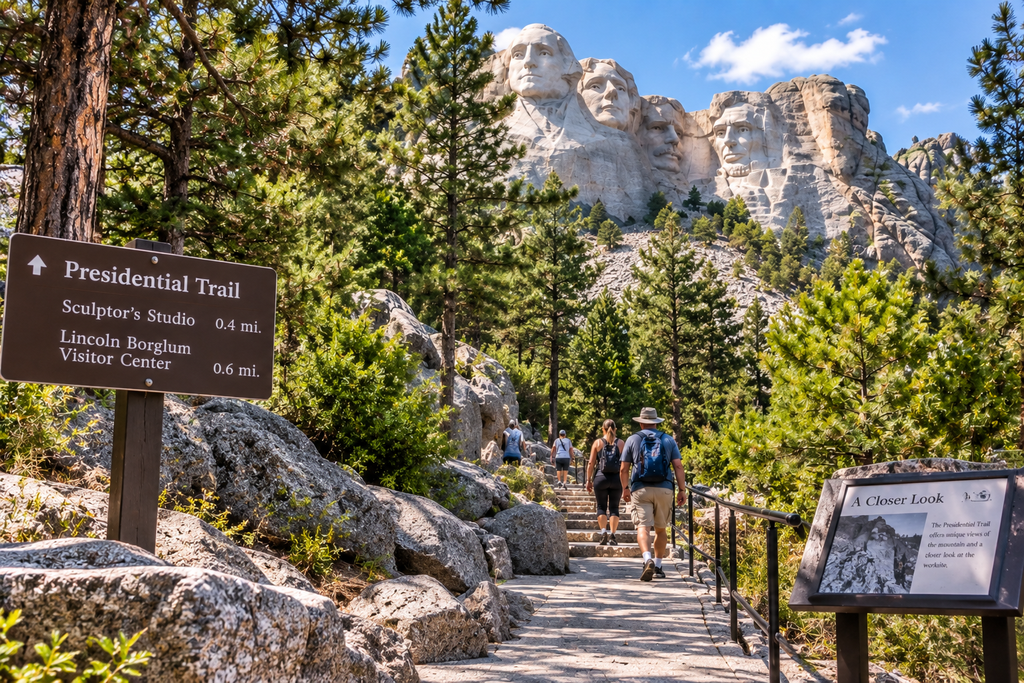
The Presidential Trail offers the closest public views of the sculpture and changes the experience more than its relatively short distance might suggest. The route extends approximately six-tenths of a mile, beginning at the Grand View Terrace and looping through the ponderosa pine forest toward the base of the mountain and Sculptor’s Studio.
The first portion from the Grand View Terrace is surfaced and wheelchair accessible for approximately two-tenths of a mile. Along this section, viewing areas provide increasingly close perspectives of the presidents. From certain angles, one face dominates while the others partially disappear behind the contours of the mountain. Details that blend together from the main terrace—Washington’s eyes, Roosevelt’s glasses, Lincoln’s beard, and the rough granite surrounding each face—become more distinct.
Beyond the accessible portion, the character of the trail changes. The remaining route includes uneven terrain and 422 stairs, with a combination of descents and climbs as it continues toward Sculptor’s Studio. The loop is manageable for many visitors, but it is not simply a level stroll. Anyone with knee problems, limited stamina, balance concerns, or difficulty climbing stairs should consider enjoying the accessible viewing areas and returning along the same route.
The forest also changes the atmosphere. The sound and activity of the main terrace begin to fade beneath the rustle of ponderosa pines, birdcalls, and the rhythm of footsteps and breathing on the stairs. Sun and shade alternate across the path, and the air can feel cooler away from the exposed terrace. The mountain appears intermittently between trees and granite outcroppings, making each opening feel like a new introduction. Interpretive signs identify the presidents and explore aspects of the landscape, wildlife, and construction story.
Walking the complete trail is not required to appreciate Mount Rushmore. However, for visitors physically comfortable with the stairs, it provides the strongest sense of standing beneath the sculpture rather than merely looking toward it from a distance. Looking upward from the trail, with forest around you and granite above, can make the scale feel more real than the classic terrace view alone.
🛠️ The Sculptor’s Studio
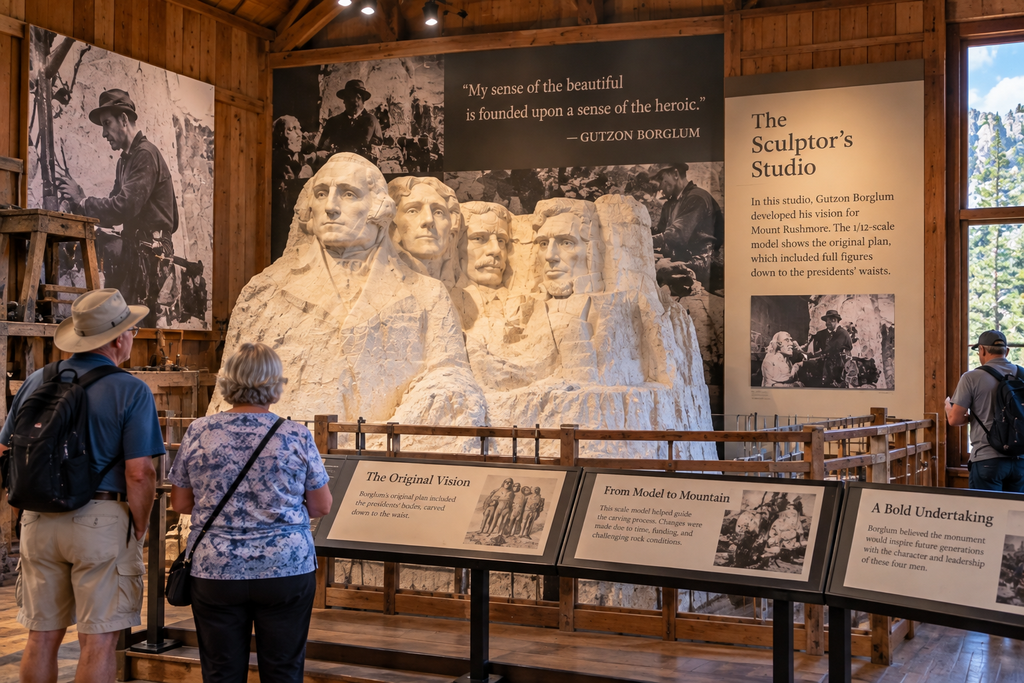
Located near the lower portion of the Presidential Trail, the Sculptor’s Studio brings the construction story into clearer focus. The building contains Gutzon Borglum’s scale model of the sculpture, which workers used to transfer measurements from the studio to the mountain.
The model is particularly revealing because it shows differences between Borglum’s intended design and the memorial that was ultimately completed. Seen at close range, it invites visitors to trace the shapes and imagine those proportions enlarged onto the mountain. Borglum’s vision extended beyond the four finished faces, but work ended in 1941 following his death and the loss of federal funding as the United States approached entry into World War II.
Seasonal ranger talks at the studio explain the tools, measurements, and carving techniques used by the workers. Listening to the account of crews removing rock with dynamite and refining the surface while suspended high above the ground makes the silent mountain feel less like a distant monument and more like an enormous work site filled with blasts, drills, dust, and shouted instructions.
The Sculptor’s Studio operates seasonally and closes earlier than some of the memorial’s other facilities. Visitors who consider it an important part of their Mount Rushmore tour should check the day’s hours before postponing it until late afternoon.
🪶 Encountering the Black Hills’ Deeper Story
Mount Rushmore cannot be fully understood without recognizing that its story did not begin with the carving of four presidents. The memorial stands in the Black Hills, a landscape long considered sacred by the Lakota and important to numerous Indigenous nations.
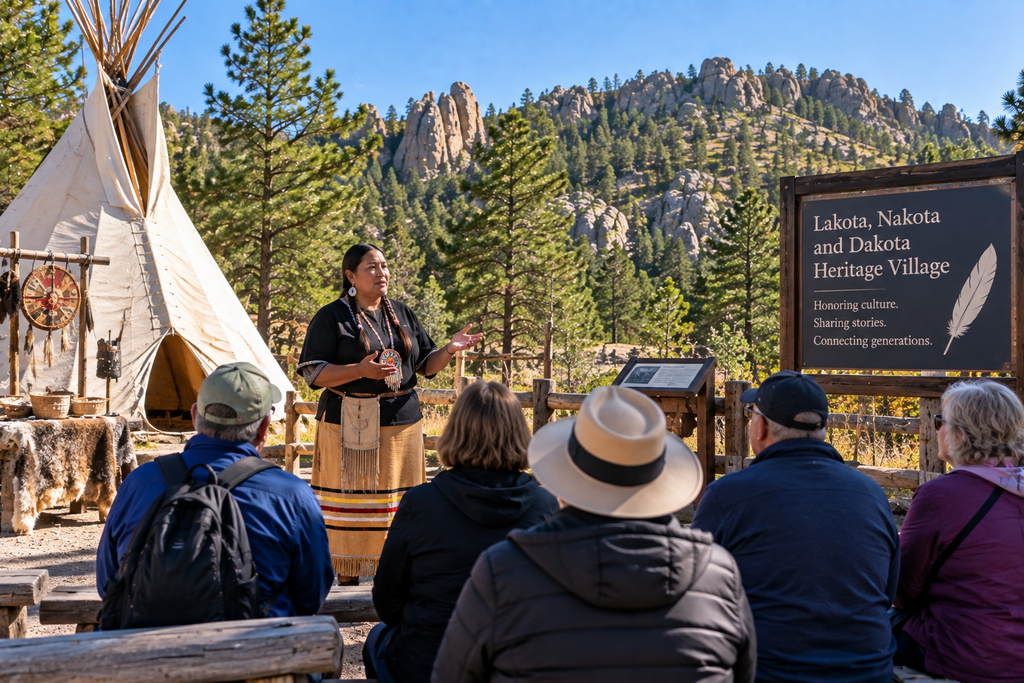
During the primary visitor season, the Lakota, Nakota and Dakota Heritage Village along the first portion of the Presidential Trail presents traditions, history, and perspectives connected to the region’s Native communities. Programs may include storytelling, music, cultural interpretation, and discussions of the continuing significance of the Black Hills. Hearing these voices within the landscape itself can add an emotional and human dimension that a sign or timeline alone cannot convey.
Seasonal hoop-dance performances and other cultural programs may also take place on the Grand View Terrace. These experiences do not erase the conflicting meanings associated with the memorial, nor do they reduce a complex history to one interpretation. Instead, they remind visitors that the mountain exists within a cultural landscape far older and more complicated than the monument itself.
Programming schedules vary by date, season, staffing, and weather. Visitors interested in these presentations should check the posted schedule at the Information Center or on the National Park Service’s current Mount Rushmore program page.
🌙 Seeing Mount Rushmore After Dark
During the summer season, the evening lighting program gives visitors a different way to experience the memorial. The program is held in the outdoor amphitheater and generally includes a ranger presentation, a film, recognition of military veterans, and the illumination of the sculpture.
The ceremony’s patriotic tone will appeal more strongly to some visitors than others, but the transformation of the mountain is memorable. As daylight fades, conversation settles, evening air replaces the heat of the terrace, and the carved faces become less distinct against the granite. When the lights come on, they reappear above the darkened forest with a theatrical intensity completely different from the daytime view. Music, narration, and the response of the audience make this a shared experience rather than simply another look at the sculpture.
Visitors who arrive early enough can experience the memorial in daylight, have dinner, explore the museum or trail, and then return to the amphitheater. Those who visit earlier in the day can also use the same parking ticket to reenter later, provided they return in the same vehicle.
The formal evening program usually operates from late May through September. At other times of the year, the sculpture may still be illuminated after sunset without the accompanying ceremony. Hours and starting times change seasonally, so confirm them through the official Mount Rushmore operating-hours page before arranging an evening visit.
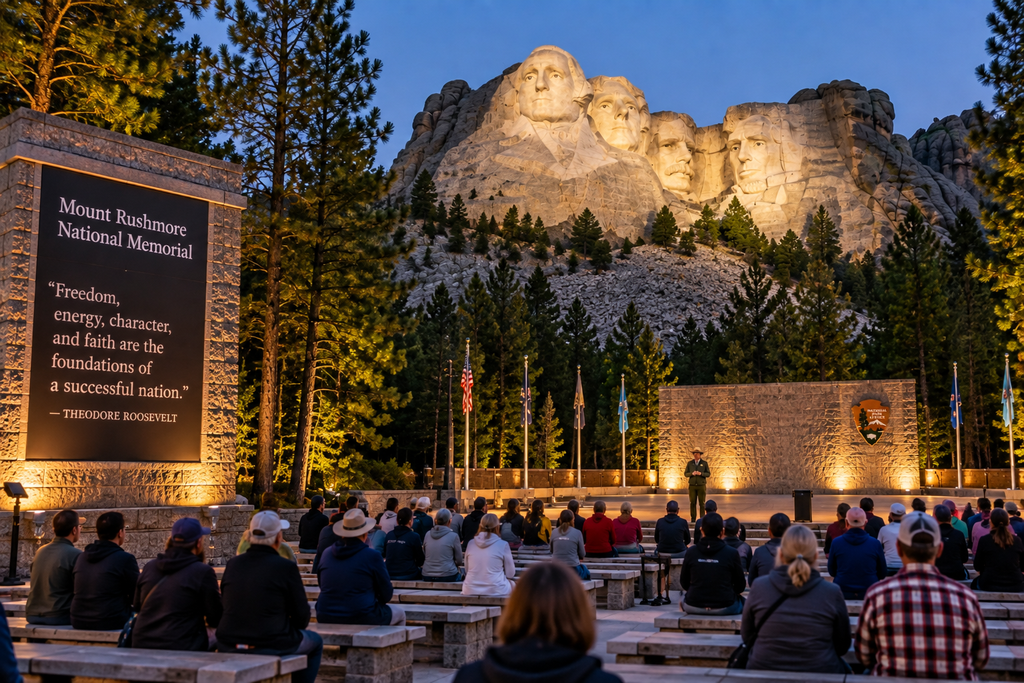
As darkness settles over the Black Hills, visitors gather in the amphitheater for the evening program and the illumination of Mount Rushmore.⭐ The Moments Visitors Are Most Likely to Remember
Mount Rushmore’s fame can create the impression that the visit will consist of one familiar view. In reality, the experience changes as visitors move through the memorial and see the mountain from different distances, angles, and times of day.
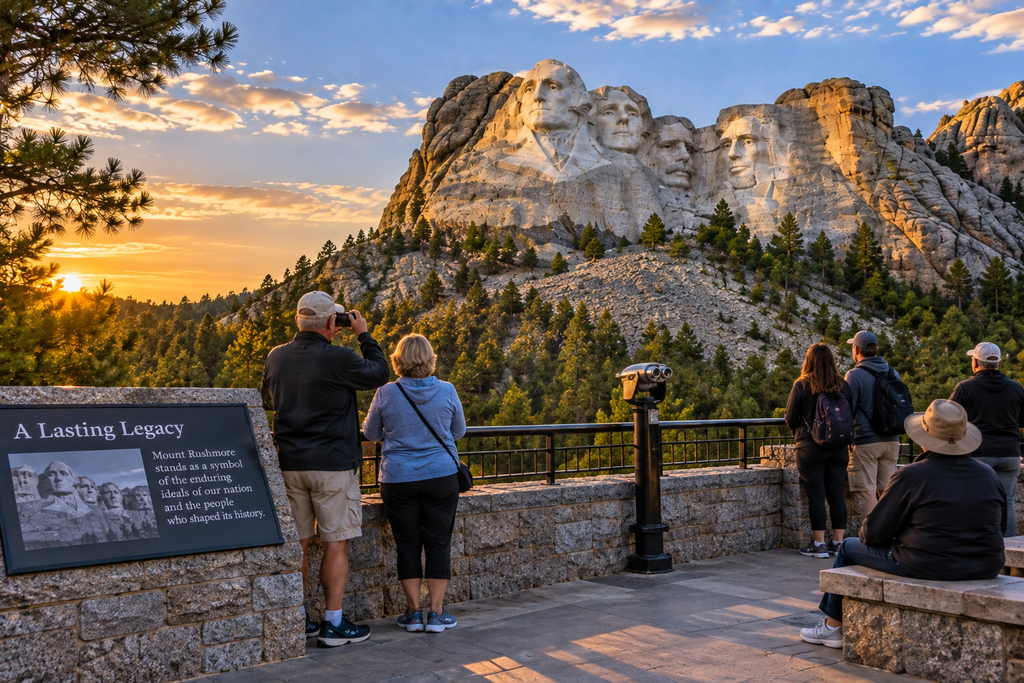
Several moments are especially likely to define the visit:
- Hearing the flags move overhead as the sculpture comes fully into view
- Standing on the Grand View Terrace for the first unobstructed look at all four presidents
- Feeling the terrace noise recede as the faces appear between the trees along the Presidential Trail
- Studying Borglum’s model and construction tools inside the Sculptor’s Studio
- Hearing Native history and cultural interpretation within the Black Hills landscape
- Feeling the evening air and watching the sculpture emerge from the darkness during illumination
Visitors who only stop for the main photograph will still have seen Mount Rushmore, but those who explore the trail, visitor center, studio, and programs are more likely to understand it. The difference is not simply spending more time at the memorial; it is discovering how many stories exist behind one famous view.
♿ Accessibility and Policies That Affect the Experience
Most principal visitor facilities at Mount Rushmore are accessible, including the Information Center, Grand View Terrace, Lincoln Borglum Visitor Center, amphitheater, Carvers’ Café, and gift shop. Elevators connect the parking levels and main visitor areas, while designated accessible parking and passenger drop-off options are available. Manual wheelchairs can also be checked out without charge at the Information Center on a first-come, first-served basis.
The first two-tenths of a mile of the Presidential Trail are surfaced for wheelchair access and lead to viewing areas near the mountain. The remaining four-tenths of a mile are not accessible and include 422 stairs. Access to the Sculptor’s Studio may sometimes be arranged through a separate accessible parking area, but visitors should ask a ranger because availability can be affected by security or operational conditions.
Mount Rushmore provides additional accommodations that include captioned films, Braille brochures, an audio-described brochure, and American Sign Language interpretation requested in advance. Visitors with specific needs should review the memorial’s detailed accessibility information before traveling.
The memorial’s outdoor setting also matters. Even visitors remaining near the primary terraces may encounter changing temperatures, strong sun, wind, rain, or winter conditions. Bright granite and open paving can intensify glare, while shaded trail sections may feel noticeably cooler. A complete visit can involve more standing, walking, and stair climbing than the initial approach suggests.
Photography is permitted throughout normal public areas, although drones are prohibited within National Park Service boundaries. Pets are generally limited to the parking garages and adjacent pet exercise areas; service animals meeting ADA requirements are permitted in public visitor areas. Because regulations and security requirements can change, visitors should consult the official National Park Service information shortly before arriving rather than relying on an older list of policies.
👀 Is a Mount Rushmore Tour Worth It?
Mount Rushmore is worth visiting for travelers interested in American history, monumental sculpture, presidential history, engineering, or the landscapes of the Black Hills. It is also one of those places whose cultural familiarity makes seeing it in person feel different from discovering an unfamiliar attraction. Visitors already know the image, but they have not necessarily experienced the scale, setting, or changing appearance of the granite.
The memorial may disappoint someone expecting a sprawling national park or a full-day attraction in its own right. The primary developed area is compact, and the famous view appears soon after entering. Its value comes less from the number of things to do than from the layers visitors choose to explore.
The experience is strongest when Mount Rushmore is approached as both an artistic achievement and a complicated historical place. The carving story is remarkable, the Black Hills setting can be felt in the wind, pine-scented air, granite, and changing light, and the questions surrounding the land and the figures represented there remain important. Visitors do not need to arrive with one predetermined interpretation, but they should be willing to look—and listen—beyond the photograph.
For many travelers, Mount Rushmore also serves as an anchor for a larger Black Hills journey. Its location makes it easy to combine the memorial with scenic roads, Custer State Park, Crazy Horse Memorial, historic communities, and other destinations that place its story within a broader landscape.
📅 Planning Your Visit
Once you have decided to include Mount Rushmore in your Black Hills trip, choices involving season, timing, dining, and lodging can substantially shape the experience.
Best Time to Visit
June, July, and August bring the warmest weather, the fullest schedule of ranger programs, and the nightly lighting ceremony. They also bring the largest crowds. The National Park Service recommends considering arrival before 9:00 a.m. or after 3:30 p.m. during the busiest summer months.
May, September, and October can provide a quieter experience with cooler temperatures, although some seasonal programs and facilities may operate on reduced schedules. Weather in the Black Hills can change quickly, and snow is possible outside the summer season.
Early morning often provides cooler temperatures, softer light, quieter walkways, and more room on the viewing terrace. Late afternoon can be less crowded, while an evening visit lets visitors feel the memorial change as daylight drains from the granite and the air cools before illumination. Photographers should remember that the position of the sun and passing clouds can dramatically change how clearly each face appears.
Winter offers solitude and a snow-covered landscape, but visitors should expect limited services, possible trail closures, colder conditions, and shorter facility hours. Checking the memorial’s current conditions is particularly important outside the main season.
How Much Time to Allow
Allow approximately one to two hours for a comfortable visit that includes the Grand View Terrace, Lincoln Borglum Visitor Center, and a portion of the Presidential Trail. Visitors who walk the complete trail, attend a ranger program, explore the Sculptor’s Studio, browse the exhibits, and stop for food may spend three to four hours.
Remaining for the evening lighting ceremony can turn Mount Rushmore into a half-day or late-afternoon-to-evening experience. Because the parking ticket permits reentry for a year, another option is to visit during the day, explore elsewhere in the Black Hills, and return for the ceremony.
A very short stop is possible, but it reduces Mount Rushmore to its most familiar photograph. Allowing even one additional hour creates time to see how the memorial was made and why its setting continues to matter.
Parking, Fees, and Reservations
No reservation is required to enter Mount Rushmore or attend its regular ranger programs and evening lighting ceremony. The memorial does not charge an entrance fee, but the parking facility charges a fee that is not covered by America the Beautiful or other national park passes.
Parking fees, exemptions, and operating arrangements can change. Check the official Mount Rushmore fees and parking information before visiting. Overnight parking is not permitted.
What to Wear
Comfortable walking shoes are important if you plan to use the Presidential Trail, particularly on the section containing stairs. Clothing should suit the Black Hills weather rather than the temperature at your hotel because conditions at the memorial can be cooler, windier, or wetter than expected.
During summer, bring sun protection and water. A light jacket or layer can be useful for the evening ceremony even after a warm day. In spring, fall, and winter, footwear with good traction may be necessary when walkways are wet, snowy, or icy.
Places to Dine
Carvers’ Café is the only full dining facility inside Mount Rushmore National Memorial. It offers a convenient place for breakfast, lunch, dinner, or a break between the daytime experience and evening lighting program. Seasonal ice cream service includes the popular “Thomas Jefferson ice cream,” inspired by a recipe associated with Jefferson.
Dining at the memorial is primarily about convenience and the novelty of eating beneath the mountain. Hours change considerably by season, so visitors planning a meal should check the current Mount Rushmore dining and operating hours before arriving.
Keystone, the closest community, offers additional casual restaurants, cafés, sweets, and family dining. Hill City, Custer, and Rapid City provide broader choices for travelers who want dinner to become a larger part of the day rather than simply a pause during the memorial visit. The state’s official Mount Rushmore dining guide provides a starting point for comparing current options.
Places to Stay
There is no lodging within Mount Rushmore National Memorial, but several nearby communities make convenient bases for exploring the memorial and the rest of the Black Hills. The best choice depends not only on how close you want to be to Mount Rushmore, but also on where the larger journey will take you.
Keystone, the closest community, is the most convenient choice for visitors who want easy access to the memorial or plan to return for the evening lighting ceremony. Hotels, motels, cabins, restaurants, and visitor attractions are concentrated nearby, making it especially practical for a short stay centered on Mount Rushmore.
Travelers planning a broader Black Hills experience may prefer Hill City or Custer. Hill City has a relaxed small-town atmosphere with galleries, restaurants, wineries, cabins, and access to the 1880 Train. Its central location works particularly well when Mount Rushmore and Crazy Horse Memorial are both important parts of the trip. Farther south, Custer provides a useful base for exploring Custer State Park, Wildlife Loop Road, Needles Highway, and the southern Black Hills, with accommodations ranging from traditional hotels and motels to cabins and campgrounds.
Rapid City is farther from Mount Rushmore but offers the largest selection of hotels, restaurants, shopping, and other services. It may be the most practical choice for visitors whose plans extend beyond the central Black Hills to Badlands National Park, Minuteman Missile National Historic Site, or destinations farther north.
In short, Keystone offers the greatest convenience, Hill City provides a central location with small-town character, Custer places visitors closer to wildlife and scenic drives, and Rapid City offers the broadest range of accommodations and services. Current lodging options can be compared through Travel South Dakota’s places to stay near Mount Rushmore.
💭 When I Visit Mount Rushmore
Mount Rushmore is one of those places whose image is so familiar that I wonder how different the real place will feel. I expect the first view of the mountain to be memorable, but I am even more interested in the complete experience—the flags moving overhead, the changing light on the granite, the quieter air beneath the pines, and the stories that reveal the labor, ambition, and conflict behind the familiar faces.
When I visit, I do not want simply to take the photograph and leave. I want to move through the memorial, listen to its stories, and understand the many layers of history surrounding it. The famous image may be what draws me there, but I believe the setting and the stories behind it will be what give the visit its meaning.
🛣️ As You Travel On
Mount Rushmore may be the most recognizable landmark in the Black Hills, but it tells only one part of the region’s story. Nearby roads carry travelers through pine-scented forests, narrow granite tunnels, mountain lakes, wildlife habitat, historic towns, and places that present very different perspectives on the land and its past.
Crazy Horse Memorial offers an important companion experience, while Iron Mountain Road reveals carefully framed views of Mount Rushmore through its tunnels. Custer State Park, Needles Highway, Sylvan Lake, and Wildlife Loop Road can turn a visit to the monument into a much broader encounter with the Black Hills.
Continue with Interesting Facts About Mount Rushmore You Never Knew, or explore the continuing story behind Crazy Horse Memorial as your journey through South Dakota unfolds.